
Best European Alternatives to WhatsApp
Looking for a European alternative to WhatsApp? Owned by Meta/Facebook, WhatsApp shares data with its parent company and stores metadata on US servers despite end-to-end encryption.
European messaging apps offer true privacy with no data sharing, minimal metadata collection, and servers in Europe.

How we rank these tools — 4-step process
-
1
European ownership, verified
The company is headquartered and incorporated in the EU, EEA, the UK, Switzerland or Israel, and processes customer data in Europe or Israel. A US parent company disqualifies a tool from this page regardless of where its servers are.
-
2
Category fit and hands-on review
What the tool actually does, who it suits, and where it falls short — checked against the vendor’s own documentation, changelog and pricing page rather than its marketing copy.
-
3
Compliance and pricing check
GDPR posture, hosting location and the prices quoted on this page are verified against the vendor’s public pricing before publication, and re-checked when we revisit the category.
-
4
Position on this page
Placement on this page can be paid, and that can affect which tools appear here and the order they appear in. It never buys a good review: a tool that fails the checks above is not here at any price, and payment does not change the shortcomings we write about. A vendor can ask us to correct a factual error — not to remove a criticism.
Vendors can pay for visibility on this page. It never changes what an entry says about a product, including the criticism, and we earn nothing when you click through to a vendor. Paid placement can affect which tools appear here and the order they appear in. Editorial policy
13 European Alternatives to WhatsApp

Threema
No phone number required, Swiss-hosted messaging

Element
Decentralized messaging based on Matrix protocol

Briar
Peer-to-peer messaging that works without internet

Delta Chat
Encrypted messenger built on email, so any email or chatmail server can carry it

ginlo
Munich messenger with a free private app and a managed business edition

HansaChat
German team chat billed per workspace instead of per user, hosted on IONOS Cloud in the EU - a Slack alternative for teams that grew tired of per-seat pricing

Olvid
French messenger with no phone number and no central directory, holding an ANSSI CSPN visa

Session
Decentralized messenger with no phone number required, onion routing, and community-run infrastructure - truly anonymous messaging

SimpleX Chat
UK-based messenger with no user identifiers - no phone numbers, no usernames, no accounts, just complete privacy

Revolt
Open-source Discord alternative with full customization - European alternative based in Open Source

TeamSpeak
Professional voice communication platform - European alternative based in Germany

Balsio
A newly launched Latvian messaging app for professional communication - a European alternative to WhatsApp built around EU Digital Markets Act interoperability
Key takeaways
- WhatsApp cannot read your messages, and saying it can is the fastest way to lose an argument about WhatsApp. The exposure is metadata, not content.
- Uploading your contacts hands Meta the phone numbers of people who never installed WhatsApp and never agreed to anything.
- The EEA controller is WhatsApp Ireland Limited, so the GDPR applies in full; the parent company in Menlo Park is what US legal process reaches.
- Since the Digital Markets Act, WhatsApp in Europe accepts messages from third-party services, so leaving no longer has to mean losing every contact at once.
- Threema and Briar are the two here that never learn your phone number in the first place, which is a different guarantee from encrypting what you type.
Why people leave WhatsApp
Begin with the thing this page is not going to claim. WhatsApp does not read your messages. Message content, calls and status updates are end-to-end encrypted, and Meta states that plainly in the privacy policy that applies to users in the European Economic Area. Any comparison that opens by suggesting otherwise falls apart the moment someone checks, and it deserves to.
What Meta does collect is everything around the message. Your phone number, the address book you uploaded, when you were last online, how long each call lasted, which groups you belong to, which devices you have linked. That record is shared across Meta companies for infrastructure, analytics and abuse work in the United States, the United Kingdom and Israel. Nobody reads your words; somebody can draw your life.
The second reason is newer and more practical. Under the Digital Markets Act, WhatsApp in Europe now accepts messages from third-party services.
It is not a free crossing: the EEA policy says your phone number along with some usage, device, connection and authentication information is shared with the third-party service, and WhatsApp in return learns whether a message was delivered, what type it was and when it was sent. But leaving no longer has to mean losing the group chat, which for a decade was the only argument that mattered.
- The graph is the product, not the text End-to-end encryption protects what you said. It does not protect that you said it, to whom, at what hour, how often, and for how long. That pattern is what an advertising company is built to work with, and WhatsApp is the only messenger most people carry that is owned by one. The distinction sounds academic until you imagine handing a journalist, a doctor or a lawyer a list of everyone they called last month.
- Your address book was never only yours WhatsApp asks to upload the contacts on your device, which means the numbers of people who never installed it. They did not agree to anything and cannot opt out of a decision you made. This is the one privacy harm in this category that is not about you at all, and no setting on your phone reverses it once it has happened.
- A phone number is an identity you cannot shed The account is the number, and the number is tied to a SIM, a contract and usually a name. Give someone your WhatsApp and you have given them a permanent handle on you. Two of the four tools on this page issue an identifier that has nothing to do with your telephone line, which is a different proposition rather than a nicer version of the same one.
- The Irish entity is the controller, and the American one is the parent For EEA users the data controller is WhatsApp Ireland Limited, so the GDPR applies in full and the Irish regulator is the authority you complain to. That is a real protection and this page will not pretend otherwise. It also does not change that Meta Platforms, Inc. in Menlo Park sits above it, and that a US parent is reachable by US process in a way an Irish subsidiary alone would not be.
What you have to replace, not just match
Work out which WhatsApp you are leaving, because the app does four jobs and only one of them is hard to move.
There is the one-to-one conversation with people you choose, which any of these handles on the first evening.
There is the group — the family, the five-a-side, the parents of the class — which moves only when enough of it agrees to move. There is the business account, where a company contacts you through the WhatsApp Business Platform and no consumer messenger here has an equivalent. And there is the voice and video calling, which is better on WhatsApp than most people assume.
The group is the whole difficulty. Everything else is a download.
The alternatives compared
| Position | Tool | Headquarters | Pricing | Jurisdiction |
|---|---|---|---|---|
| #1 | Threema | Pfaffikon, Switzerland | CHF 4.99 one-time (mobile) / CHF 2/user/month (Work) | Switzerland (adequacy decision, outside the EEA) |
| #2 | Wire | Zug, Switzerland | Free (personal) / SMB €7.45/user/month billed annually, €8.94 monthly | Switzerland (adequacy decision, outside the EEA) |
| #3 | Element | London, United Kingdom | Free self-hosted / from about €5/user/month (managed) | United Kingdom (adequacy decision, outside the EEA) |
| #4 | Briar | Europe (distributed team) | Free and open source | No servers to hold jurisdiction over |
How each alternative compares to WhatsApp
- Which law reaches it. Switzerland (adequacy decision, outside the EEA). WhatsApp is run from the United States, so the CLOUD Act obliges the provider to hand over data on a valid order regardless of which country the servers are in.
- Where the data sits. Switzerland.
- Source code. Open source, where WhatsApp is not: you can read what it does rather than take the description on trust.
Best for: People whose objection to WhatsApp is that the account is their phone number
Threema AG operates from Pfäffikon with Swiss hosting, and the difference you notice on the first screen is that it does not ask for your telephone number. You get a random Threema ID. Where WhatsApp is an account that is your number, Threema is an account with no identity behind it, and there is no address book upload to decline because there is nothing it needs to match against.
That removes the second-order harm the WhatsApp page has to be honest about. Uploading your contacts hands Meta the numbers of people who never installed anything. Threema has no equivalent step, so the people in your phone stay out of it entirely.
It costs CHF 4.99 once for the mobile app, and CHF 2 per user per month for Threema Work. Against a free app that is a barrier, and it is also the whole answer to how the company earns. The apps are open source and independently audited, which is the part you can check rather than believe.
What Threema does better than WhatsApp
- No phone number and no email address, where a WhatsApp account is inseparable from your number
- No contact upload, so the numbers of people who never joined stay out of it
- Paid for by its users at CHF 4.99 once, not by a company that also sells advertising
- Swiss company and Swiss hosting, with no US parent above it
- Open source apps with published independent audits, where WhatsApp publishes a protocol paper and closed clients
Where Threema is a step down from WhatsApp
- Far fewer people have it, which is the only metric that decides whether a messenger works
- The one-off fee stops exactly the casual contacts you most need to bring with you
- Mobile-to-desktop syncing has been less dependable than WhatsApp's linked devices
- None of the extras WhatsApp accumulated: no sticker marketplace, no business channel, no payments
Standout against WhatsApp. It is the only finished consumer messenger here that can be used without ever telling anyone your telephone number.
- Which law reaches it. Switzerland (adequacy decision, outside the EEA). WhatsApp is run from the United States, so the CLOUD Act obliges the provider to hand over data on a valid order regardless of which country the servers are in.
- Where the data sits. EU (Germany, Ireland).
- Source code. Open source, where WhatsApp is not: you can read what it does rather than take the description on trust.
Best for: People whose WhatsApp has quietly become half personal and half professional
Wire Swiss GmbH is registered in Zug and hosts in Germany and Ireland, which is an unusual and useful combination: a Swiss company operating under an adequacy decision, with the servers themselves inside the EU. Against WhatsApp that answers both halves of a procurement question at once.
The reason it appears on a WhatsApp page rather than only a Slack one is that most people's WhatsApp is not purely personal. Clients message it, colleagues message it, and the line between the family group and the project group stopped existing years ago. Wire is free for personal use and starts from about €7.45 per user per month for business, so the same tool covers both sides without pretending the split is clean.
What it will not do is feel like WhatsApp. It is a collaboration product with conversations in it, not a chat app with work bolted on, and the people you message socially will find it more formal than they expected.
What Wire does better than WhatsApp
- Signs you up with an email address rather than binding the account to your phone number
- Swiss company with EU hosting in Germany and Ireland, where WhatsApp's parent sits in Menlo Park
- Open source, so the client can be inspected rather than taken on trust
- One tool for the personal and professional conversations WhatsApp has already merged for you
- Group voice and video that is built for meetings rather than for catching up
Where Wire is a step down from WhatsApp
- Reads as business software, which is wrong for the family group
- Nobody you know has it, and the free personal tier is not widely advertised
- No interoperability with WhatsApp, so it is an additional app rather than a bridge
- Smaller company and a smaller ecosystem than anything Meta operates
Standout against WhatsApp. It is the only option here that covers the work half of your WhatsApp without asking you to run a server.
- Which law reaches it. United Kingdom (adequacy decision, outside the EEA). WhatsApp is run from the United States, so the CLOUD Act obliges the provider to hand over data on a valid order regardless of which country the servers are in.
- Where the data sits. Self-hosted, or European managed options.
- Source code. Open source, where WhatsApp is not: you can read what it does rather than take the description on trust.
Best for: Organisations and households that would rather host the messenger than join one
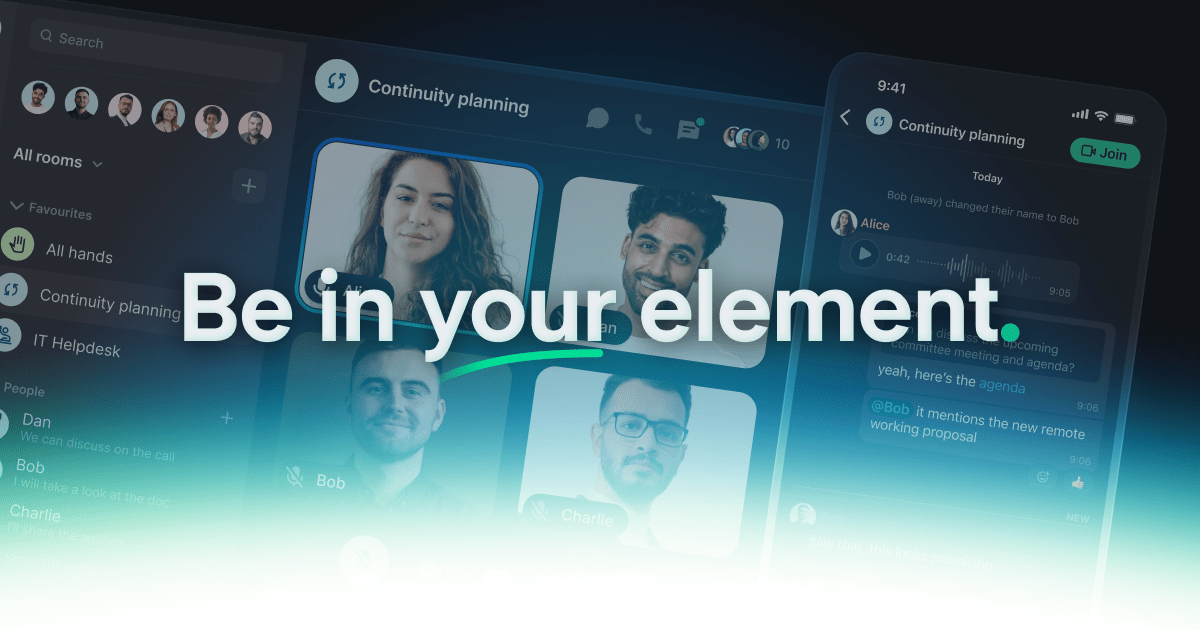
Element is built by New Vector Ltd in London on the Matrix protocol, and the difference from WhatsApp is architectural rather than cosmetic. There is no single company whose servers all messages pass through. You connect to a homeserver, which can be one someone else runs or one you run, and it federates with the others the way email does.
That is why it shows up in places where the metadata question was answered by procurement rather than by preference.
The French government runs Tchap on Matrix for more than 300,000 civil servants, Germany runs BundesMessenger for its civil service and Element inside the Bundeswehr, NATO members use the NI2CE messenger for cross-border interoperability, and the University of Innsbruck runs it for the whole institution. None of those organisations was looking for a nicer WhatsApp; they were looking for a messenger whose server they control.
For a private individual it is the most demanding option on this page. Choosing a homeserver is a decision WhatsApp never asks you to make, and the mobile apps, while much improved, still ask you to understand a concept before you can send a message.
What Element does better than WhatsApp
- Federated, so no single company holds the record of who talks to whom
- You can run the server yourself, which WhatsApp offers in no form at any price
- Already deployed by the French and German civil services and inside NATO, which is evidence rather than a claim
- Open source end to end, protocol and clients alike
- Bridges to other networks exist, so it can sit alongside what you are leaving rather than replacing it on day one
Where Element is a step down from WhatsApp
- Asks an ordinary user to understand servers and federation before the first message
- Encrypted key management and device verification are genuine friction that WhatsApp hides completely
- Running your own homeserver means somebody owns updates and backups
- The homeserver you join may be run by anyone, and vetting one is a judgement an ordinary user is not equipped to make
Standout against WhatsApp. It is the only messenger here that European governments have already deployed at national scale, which is a different kind of reassurance from an audit report.
- Which law reaches it. No servers to hold jurisdiction over. WhatsApp is run from the United States, so the CLOUD Act obliges the provider to hand over data on a valid order regardless of which country the servers are in.
- Where the data sits. None — peer-to-peer over Tor.
- Source code. Open source, where WhatsApp is not: you can read what it does rather than take the description on trust.
Best for: Journalists, organisers and anyone working where infrastructure can be cut or watched
Briar is a non-profit project with a distributed European team, and it is on this page as a deliberate outlier. There are no servers. Messages travel directly between devices over Tor, and when the internet is unavailable they pass over Wi-Fi or Bluetooth instead. There is no account, no number, no address to seize.
Against WhatsApp that is not an improvement in degree. WhatsApp's whole design assumes a company in the middle that routes, stores and delivers; Briar's design assumes that company is the problem. If your reason for leaving is that a record exists at all, this is the only option here that removes the record rather than moving it.
The cost is every convenience. There is no multi-device support, no calls, no cloud backup, and if you lose the phone you lose the conversations. It is free and open source under the GPL, and it is ranked last here because for almost everybody reading this page it is the wrong tool, which is exactly why it is worth knowing it exists.
What Briar does better than WhatsApp
- No servers at all, so there is no metadata store to subpoena, breach or sell
- Works with no internet connection, over Wi-Fi or Bluetooth, which no Meta product does
- No phone number, no email address and no account to register
- Free and open source under the GPL, with nothing to pay and nobody to pay it to
Where Briar is a step down from WhatsApp
- No voice or video calls, where WhatsApp's calling is genuinely good
- One device only, so no desktop client mirroring your phone
- Lose the handset and the conversations are gone, because there is no backup by design
- Contacts must be added in person or through a mutual contact, which makes casual use impossible
Standout against WhatsApp. It keeps working after the mobile network is switched off, which is the one scenario no European cloud messenger on this page can help with.
What actually breaks when you switch
The group is the migration. One person moving is trivial; twenty-two parents in a class chat moving is a negotiation, and there is no import tool that makes it less of one. Pick one group with a reason to care, move that, and accept that the rest follows over months or never.
Expect to run both for a long time. WhatsApp will stay on your phone for the plumber, the school and the airline, and anyone who tells you they deleted it in a weekend either has no such contacts or is not being straight with you. The realistic goal is to move the conversations you would mind being profiled, not all of them.
And check what you are handing over on the way out. Exporting a chat gives you a text file and its attachments, which is fine for keeping, but deleting your account does not retrieve the address book you uploaded years ago or unwind what other people's uploads already recorded about your number.
If the encryption is good, what exactly am I gaining?
You are gaining the part WhatsApp does not cover. Every alternative on this page also encrypts message content, so that is not what separates them. What separates them is how much a server learns while doing it.
With WhatsApp, the server knows your number, the numbers in your address book, who is in which group, when each of you was last online and how long yesterday's call ran. With Threema there is no number to know. With Briar there is no server. Those are structural differences, not settings you switch on.
If your objection to WhatsApp was that Meta reads your chats, the honest answer is that it does not, and you may decide the metadata does not bother you. Plenty of people reasonably land there. The point of this page is that the decision should be made about the right thing.
Does the DMA mean I can keep talking to people who stay on WhatsApp?
Partly, and the detail matters. WhatsApp in Europe now accepts messages from third-party messaging services that connect to it. What crosses is documented rather than unlimited: your phone number and some usage, device, connection and authentication information go to the third-party service, and WhatsApp receives delivery state, message type and a timestamp. It is narrower than a full WhatsApp account, and it is not nothing.
It is not a general amnesty. Each third-party service has to build and maintain the connection, and none of the four tools here has made that its headline feature. Treat interoperability as a reason the wall is lower than it was in 2023, not as a reason you can leave today and notice nothing.
The practical version is still the boring one: move the conversations you care about, keep WhatsApp installed for the dentist and the football club, and let the balance shift over a year.
Is a paid messenger a strange idea?
It is the least strange thing on this page. Threema costs CHF 4.99 once for the mobile app, and CHF 2 per user per month for the business edition. That is the entire business model: the company is paid by the people using it.
WhatsApp is free because Meta earns elsewhere, and the metadata described above is part of how the group knows who you are. Neither arrangement is dishonest, but only one of them is legible from the outside.
The obstacle is not the money, it is that a friend will not pay CHF 4.99 to talk to you. That is why the free options on this page matter even if the paid one is technically the strongest.
Which of these can my parents actually use?
Threema, without reservation. It behaves like a messenger, the apps are finished, and the only unusual step is entering an ID instead of a number.
Wire is fine for an adult who already uses a work chat tool, and its free personal tier exists precisely for this. Element asks the user to understand that there are servers and that theirs is one of many, which is one concept too many for most households.
Briar is not a family messenger and does not want to be. It is for situations where the network itself is hostile, and recommending it to a relative who wants to send photographs is how these pages lose people.
Which one to pick
If your objection is that your account is your phone number and your address book went to Meta, Threema is the direct answer and the CHF 4.99 is the least of your problems. The obstacle is persuading anyone else to install it.
If your WhatsApp has become half work, Wire covers both halves with a Swiss company and servers in Germany and Ireland, and the free personal tier means you can test that claim before paying anything.
If you are deciding for an organisation rather than for yourself, Element is the one with a track record at scale in European public administration, and the ability to run the homeserver yourself is the feature that put it there.
And if the existence of any record is the problem, Briar is the only honest answer on this page. It will cost you calls, backups and every convenience you are used to, and for the small number of people who need it that trade is not close.
Frequently Asked Questions
Threema if you want a finished consumer messenger and are willing to pay CHF 4.99 once. Wire if you also need it to work for a small team and want a free personal tier. Element if you or your organisation wants to run the server the messages pass through. Briar if you are working somewhere the network cannot be trusted. Those are four genuinely different propositions, not four rankings of the same thing.
No. Message content, calls and status updates are end-to-end encrypted and Meta says so in its own EEA privacy policy. What Meta does hold is the surrounding record: your number, the contacts you uploaded, timestamps, call durations, group membership and last-seen state, shared with other Meta companies for analytics and support work in the United States, the United Kingdom and Israel.
Yes, fully. For users in the European Economic Area the data controller is WhatsApp Ireland Limited, which makes the Irish Data Protection Commission the lead supervisory authority and gives you every right the regulation grants. The complaint on this page is not that the law cannot reach WhatsApp. It is what WhatsApp lawfully collects, and that Meta Platforms, Inc. in Menlo Park sits above the Irish entity.
Not with Threema, which issues a random ID instead, and not with Briar, which has no account system at all. Wire and Element both accept an email address rather than a telephone number. Compared with WhatsApp, where the account simply is the number, all four change the shape of what you hand over on the first screen.
It stays on your phone. WhatsApp can export a conversation as a text file with its attachments, and that export is readable but is not a format any of these tools imports into its own timeline. In practice people keep the export as an archive and start the new app empty, which is less painful than it sounds because chat history is consulted far less often than email.
Yes, and this is the only part of leaving WhatsApp that is genuinely hard. A group moves when enough of it agrees to move, and nothing technical solves a social problem. The usual approach is to move one group that has a reason — a project, a committee, a family that already complains about Meta — and let the rest follow or not.
No, and that gap is worth naming. If a company reaches you through the WhatsApp Business Platform, none of the four tools here offers an equivalent channel for that company to use. These are personal and team messengers. Replacing a business messaging channel is a separate project with a separate shortlist.
Wire and Element both do voice and video, including group calls, and Wire is built around the assumption that a team will use it for meetings. Threema has calls and they are fine for one-to-one. Briar deliberately has none, because a real-time call over a peer-to-peer Tor network is not a thing anyone should promise.
For this particular decision it matters less than usual, because the strongest tools here hold almost nothing to hand over. Threema is Swiss and operates under an adequacy decision, Wire is a Swiss company with EU hosting in Germany and Ireland, Element is British and outside the EU since Brexit, and Briar has no servers to place anywhere. Ask what the provider stores before you ask which flag it stores it under.
Related comparisons
European tools head to head
About the author
Explore More European Alternatives
Discover privacy-focused European alternatives to other popular US tech services.