
Best European Alternatives to Slack
Looking for a European alternative to Slack? While Slack is popular for team communication, it's owned by Salesforce and stores all messages on US servers accessible to the company.
European team messaging platforms offer secure collaboration with data sovereignty and self-hosting options.

How we rank these tools — 4-step process
-
1
European ownership, verified
The company is headquartered and incorporated in the EU, EEA, the UK, Switzerland or Israel, and processes customer data in Europe or Israel. A US parent company disqualifies a tool from this page regardless of where its servers are.
-
2
Category fit and hands-on review
What the tool actually does, who it suits, and where it falls short — checked against the vendor’s own documentation, changelog and pricing page rather than its marketing copy.
-
3
Compliance and pricing check
GDPR posture, hosting location and the prices quoted on this page are verified against the vendor’s public pricing before publication, and re-checked when we revisit the category.
-
4
Position on this page
Placement on this page can be paid, and that can affect which tools appear here and the order they appear in. It never buys a good review: a tool that fails the checks above is not here at any price, and payment does not change the shortcomings we write about. A vendor can ask us to correct a factual error — not to remove a criticism.
Vendors can pay for visibility on this page. It never changes what an entry says about a product, including the criticism, and we earn nothing when you click through to a vendor. Paid placement can affect which tools appear here and the order they appear in. Editorial policy
11 European Alternatives to Slack

Element
Decentralized team chat with Matrix federation

Nextcloud Talk
Team chat integrated with your file storage

Briar
European peer-to-peer messenger with Tor routing that works without internet - designed for activists and journalists

Delta Chat
Encrypted messenger built on email, so any email or chatmail server can carry it

ginlo
Munich messenger with a free private app and a managed business edition

HansaChat
German team chat billed per workspace instead of per user, hosted on IONOS Cloud in the EU - a Slack alternative for teams that grew tired of per-seat pricing

Olvid
French messenger with no phone number and no central directory, holding an ANSSI CSPN visa
Session
Decentralized messenger with no phone number required, onion routing, and community-run infrastructure - truly anonymous messaging

SimpleX Chat
UK-based messenger with no user identifiers - no phone numbers, no usernames, no accounts, just complete privacy

Devana
Polish team and community chat where you pay per space, not per person; servers in Poland
Key takeaways
- Slack does offer EU data residency, on Business+ as well as Enterprise, in Frankfurt, Paris, Stockholm, Zurich and London. Any page that tells you otherwise has not checked.
- What residency never covers is member profiles, workspace and channel membership, seat counts and analytics, which together describe your organisation more precisely than most of its messages do.
- Enterprise Key Management stores your keys in Amazon's Key Management Service, so the safeguard against one US provider is held by another.
- Wire is the only option here that encrypts team conversation end to end by default, which is the gap no Slack plan closes.
- Nextcloud Talk is the cheapest credible answer for an organisation that already runs Nextcloud, because the chat arrives with the file server rather than as a second subscription.
Why people leave Slack
Clear one thing out of the way first, because it is the claim most comparison pages lead with and it is wrong. Slack does offer European data residency, and not only at the top of the price list: Business+ and Enterprise customers can pin messages, canvases, files and the search index to Frankfurt, Paris, Stockholm, Zurich or London. Slack even sells Enterprise Key Management, where the customer holds the encryption keys.
The argument has to be sharper than geography, and Slack's own documentation supplies it. Whichever region you choose, member profiles, workspace and channel membership, seat counts, analytics and Slack-generated identifiers stay outside it. Whichever keys you hold, EKM covers messages, files and the index but not profiles, channel names, channel topics, channel descriptions, file names or who belongs to what. And the customer keys themselves live in Amazon's Key Management Service.
So at the most expensive configuration Slack sells, you can put every word your company has written inside the EU, hold the key yourself, and the shape of your organisation — who works on what, with whom, in which named room — still sits with a San Francisco company that has been part of Salesforce since 2021.
- Residency and key management stop at the org chart Slack publishes exactly what falls outside the region you choose and outside the keys you hold, and in both lists the same things recur: who your members are, which channels exist, what they are called and who is in them. For a workspace with channels named after clients, acquisitions or incidents, that metadata is frequently more revealing than the messages inside them. Nothing on Slack's price list moves it.
- The keys that protect you from a US provider sit with a US provider Enterprise Key Management is a genuine control and it deserves credit. It is also an add-on restricted to Enterprise Grid and Enterprise+, and the customer-managed keys are stored in Amazon's Key Management Service. If your risk assessment is about American legal process reaching an American company, putting the key in AWS has narrowed the problem rather than removed it.
- Ninety days, and then your own memory is behind a paywall On the free plan only the last ninety days of a workspace are visible. The older messages are not deleted; they return the moment you pay. Whatever you think of that commercially, it means the thing being priced is an organisation's recollection of its own decisions, and that is an odd asset to rent.
- It is not end-to-end encrypted, and it was never going to be Slack encrypts in transit and at rest and holds the keys unless you buy EKM, because search, link previews, compliance export and now AI summaries all require the service to read what you wrote. That is a coherent product decision rather than an oversight. It also means the baseline Slack — the one almost every customer is actually on — is a readable archive of everything your staff typed, including direct messages.
What you have to replace, not just match
Slack is three things in one subscription, and only one of them is chat. Decide which you are actually buying before you shortlist anything.
The first is the conversation: channels, threads, direct messages. Everything on this page does that competently and you will not choose on it. The second is the integration surface — the deploy notices, the alert routing, the incident bot, the approval flows that somebody wired in years ago and nobody has documented since. The third is Slack Connect, the shared channels with clients, agencies and suppliers who are on their own Slack.
The second and third are where migrations stall. Make the list of connected apps and external shared channels first. If that list is long, the honest answer may be that you keep Slack for the outside world and move the internal conversation somewhere your legal team is happier with.
The alternatives compared
| Position | Tool | Headquarters | Pricing | Jurisdiction |
|---|---|---|---|---|
| #1 | Wire | Zug, Switzerland | Free (personal) / SMB €7.45/user/month billed annually, €8.94 monthly | Switzerland (adequacy decision, outside the EEA) |
| #2 | Element | London, United Kingdom | Free self-hosted / from about €5/user/month (managed) | United Kingdom (adequacy decision, outside the EEA) |
| #3 | Nextcloud Talk | Stuttgart, Germany | Free self-hosted / Enterprise plans on request | EU (Germany) |
| #4 | Devana | Poland (city not stated on the pages read) | Prices per space, excl. VAT, per the pricing page at devana.chat (checked 15 October 2026). Community: free (unlimited users, 1 GB storage, 3 private rooms, 1 month message history). PRO Start: €19/month (5 users, 50 GB). PRO Team: €49/month (15 users, 150 GB). PRO Business: €109/month (50 users, 400 GB). The PRO plans are not on sale yet: the site says payments go live together with the PRO plans and for now only a waitlist is open, with no launch date. Several PRO features (guests, room archiving, content export, audit log, allowed-email-domain sign-in, voice/video participants) are marked 'soon'. | EU (Poland) |
How each alternative compares to Slack
- Which law reaches it. Switzerland (adequacy decision, outside the EEA). Slack is run from the United States, so the CLOUD Act obliges the provider to hand over data on a valid order regardless of which country the servers are in.
- Where the data sits. EU (Germany, Ireland).
- Source code. Open source, where Slack is not: you can read what it does rather than take the description on trust.
Best for: Teams whose objection is that the archive is readable by the provider
Wire Swiss GmbH in Zug encrypts team conversation end to end by default, with hosting in Germany and Ireland. That is the specific thing Slack does not do at any price: Slack encrypts in transit and at rest and holds the keys, and even Enterprise Key Management leaves profiles, channel names and file names outside the customer's control.
It is priced in the same territory as the Slack tier you would need for residency — about €7.45 per user per month for business, billed annually, against €15 for Business+ billed annually — which makes the comparison unusually clean. You are not paying a premium for encryption here; you are paying less for more of it.
The trade is real and you should test it. Workspace-wide search across encrypted history is weaker than Slack's, the integration catalogue is a fraction of the size, and a team that uses Slack as a notification bus will find the bots it depends on have no equivalent.
What Wire does better than Slack
- End-to-end encrypted by default, where no Slack plan offers it and EKM is key management instead
- Swiss company with EU hosting, against a US corporation owned by Salesforce
- Open source, so the encryption claim can be inspected rather than accepted
- Cheaper per seat than the Slack tier you need before data residency is even available
- Guest rooms for external participants without requiring them to run their own workspace
Where Wire is a step down from Slack
- Search across encrypted history cannot match Slack's, which is the feature daily users notice
- A small integration catalogue next to Slack's, so alerting and deploy notices need rebuilding
- No equivalent of Slack Connect for standing shared channels with client organisations
- Fewer people arrive already knowing it, so there is a training cost Slack does not carry
Standout against Slack. It is the only tool on this page where the provider cannot read the workspace, and it costs less per seat than the Slack plan that merely lets you choose a city.
- Which law reaches it. United Kingdom (adequacy decision, outside the EEA). Slack is run from the United States, so the CLOUD Act obliges the provider to hand over data on a valid order regardless of which country the servers are in.
- Where the data sits. Self-hosted, or European managed options.
- Source code. Open source, where Slack is not: you can read what it does rather than take the description on trust.
Best for: Organisations that want to own the server and still talk to other organisations
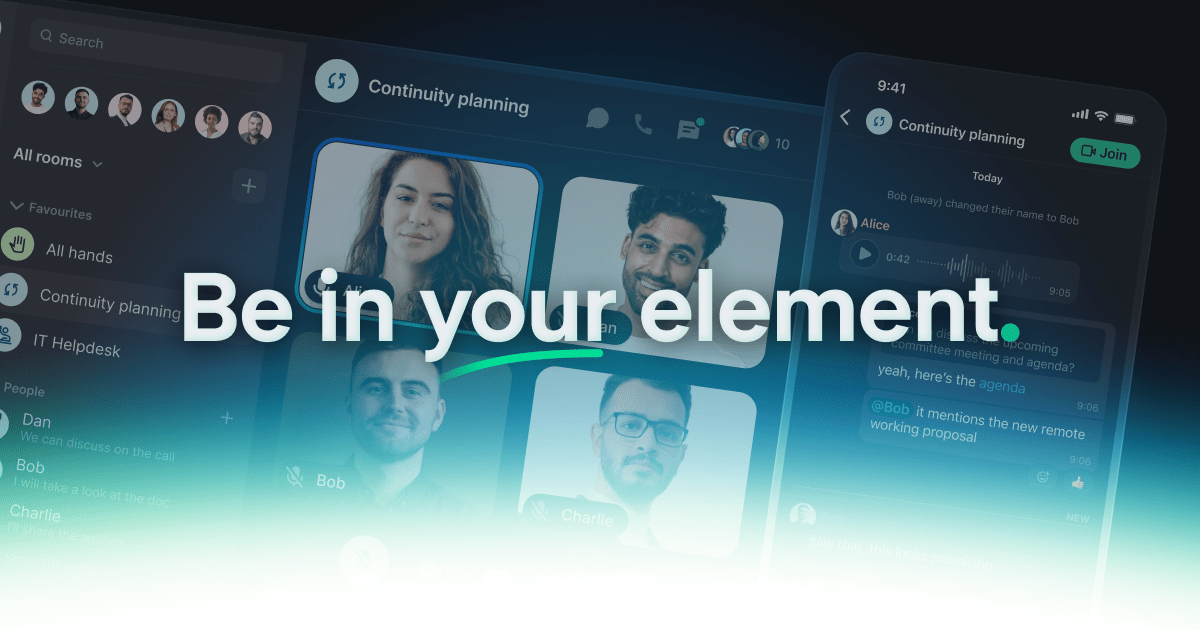
Element, from New Vector Ltd in London, is a client for Matrix, and Matrix federates. That changes the question from which company hosts our chat to which server our accounts live on, and the answer can be one you run. Slack offers nothing comparable: there is no self-hosted Slack and there never has been.
Federation also does something Slack solves with a proprietary feature. Slack Connect lets two Slack customers share a channel; Matrix lets a room contain people from servers run by unrelated organisations, with no shared vendor at all. For a consortium, a supply chain or a public body working with contractors, that is the structural version of the same outcome.
It is embedded in European public administration already. openDesk, the German administration's productivity suite, carries it as its messaging layer, which is a deployment record no other tool on this page can point at. The cost is complexity: homeserver choice, device verification and encrypted key backup are all concepts Slack successfully hides from its users, and Element does not.
What Element does better than Slack
- Can be self-hosted in full, which Slack has never offered in any edition
- Federation lets separate organisations share a room without sharing a vendor
- Open source protocol and clients, so nothing about the data path has to be taken on trust
- Adopted inside German public administration as part of openDesk, rather than only pitched at it
- Free self-hosted with no seat count, against €15 per user per month for Slack Business+
Where Element is a step down from Slack
- Device verification and key backup are visible friction that Slack users have never had to think about
- Running a homeserver, and a media relay for calls, is a real operational job
- The integration ecosystem is small next to Slack's app directory
- New Vector Ltd is London-based, so outside the EU since Brexit and reliant on the UK adequacy decision
Standout against Slack. It is the only option here where two different organisations can share a channel without both being customers of the same company.
- Which law reaches it. EU (Germany). Slack is run from the United States, so the CLOUD Act obliges the provider to hand over data on a valid order regardless of which country the servers are in.
- Where the data sits. Wherever you host it.
- Source code. Open source, where Slack is not: you can read what it does rather than take the description on trust.
Best for: Organisations that have Nextcloud and are paying Slack alongside it
Nextcloud GmbH in Stuttgart ships Talk as part of the AGPL platform, so for an organisation already running Nextcloud the chat arrives with the files, the calendar and the document editing rather than as a separate subscription. Against a Slack Business+ bill of €15 per user per month, that is the cheapest credible line on this page.
The integration is the point rather than a bonus. A conversation can hang off the folder it is about, a call can be started from a document, and the permissions are the ones you already configured for the files. Slack keeps the conversation and the content in different companies and bridges them with an app.
Talk on its own is not a Slack replacement for a large organisation. Channel and thread handling is plainer, search is weaker, and group calls need a separate high-performance backend deployed and sized before they work at scale. If Nextcloud is not already in the building, this is the wrong entry point.
What Nextcloud Talk does better than Slack
- Included in a platform many European organisations already run, so no new per-seat licence at all
- Chat, files, calendar and document editing under one administration instead of one subscription per function
- German company under AGPL, with the option to host it yourself and end the jurisdiction question
- Conversations attached to the folders and documents they concern, which Slack can only approximate through apps
Where Nextcloud Talk is a step down from Slack
- Threads, search and message formatting are noticeably plainer than Slack's
- Group calls need a separate high-performance backend installed and scaled before they are dependable
- Almost no third-party integrations, so Slack's alerting and deploy notices have nowhere to go
- Pointless unless Nextcloud is already part of your estate, since nobody should adopt a file platform to get a chat tool
Standout against Slack. It is the only option here whose licence cost for an existing Nextcloud site is genuinely nothing, which changes the business case rather than the feature list.
- Which law reaches it. EU (Poland). Slack is run from the United States, so the CLOUD Act obliges the provider to hand over data on a valid order regardless of which country the servers are in.
- Where the data sits. Application servers, databases, files, backups and e-mail at webh.pl (Polish host), data centre in Łódź, Poland. Cloudflare Turnstile (bot check at sign-in) and Google/Apple push notifications are processed outside the EU, per the privacy policy..
- Source code. Closed source, as Slack is.
Best for: Small teams and communities that dislike per-seat billing and can wait
Devana is built around the exact complaint many Slack customers have: the bill grows with every person added. Its pricing page prices the space instead, at €19, €49 and €109 per month excluding VAT for 5, 15 and 50 users, against Slack's per-user plans listed on this page. Inside the plan limit, an extra person costs nothing.
The catch is availability. These PRO plans are in waitlist mode, with no launch date, and features a Slack replacement needs for business use, such as guests, audit log, room archiving, content export and sign-in limited to a company domain, are marked as coming soon on the pricing page. Free community spaces work today.
On data location, Devana's chat content and backups sit with a Polish host in Łódź, and its privacy policy names the three non-EU processors (Cloudflare Turnstile, Google and Apple push). Unlike Wire or Element on this page it makes no end-to-end encryption claim, and it has no integration catalogue comparable to Slack's, only an open API and an announced MCP server.
What Devana does better than Slack
- Pricing per space rather than per user, so adding people inside the limit costs nothing
- Servers, backups and e-mail at a Polish host (Łódź), against a US-owned provider
- Free community space with unlimited users
- Operator is an EU-based provider (Poland) with a published processor list
- Open API announced for connecting outside services
Where Devana is a step down from Slack
- Team plans cannot be bought yet, waitlist only
- Business features such as guests, audit log and export are still marked soon
- No app directory or integration ecosystem comparable to Slack's
- Single independent developer, a continuity risk compared with larger vendors
Standout against Slack. It is the only tool on this page priced per space instead of per person, though that pricing cannot be bought yet.
What actually breaks when you switch
Start with the connected apps, not the messages. Every workspace has alerts, deploy notices, on-call escalations and approval flows that somebody wired in and left running, and the list only surfaces when one of them silently stops. Pull the app inventory from the admin panel before you announce anything.
Then deal with the outside. Shared channels with clients, agencies and suppliers are Slack-to-Slack and do not travel, and those counterparties did not agree to your migration. Expect to keep a small Slack workspace alive for external collaboration for a year, and budget for it rather than discovering it.
Finally, be honest about the archive. Public channels export as JSON on any plan; private channels and direct messages need the compliance export from a higher tier, and reactions, threading and file links all degrade on the way into another tool. Most organisations keep the export as a read-only archive and start clean, which works, but it is a decision people need to be told about rather than discover.
If Slack has EU regions, why would we move at all?
Because the two things your reviewers ask about are different. Where is the data stored is answered well by Slack: pick Frankfurt or Paris on Business+ and the messages, files and search index sit there.
Who can compel the company holding it, and what is left outside the boundary, are the questions residency does not answer. Salesforce, Inc. is a US corporation, and Slack's own documentation lists member profiles, channel membership and analytics as staying outside the region you selected regardless.
If the requirement came from a checklist about storage location, turn residency on and stay. If it came from someone asking who can see the shape of the organisation, no Slack configuration addresses it and moving is the only lever you have.
What does end-to-end encryption cost us in a team chat?
The same things it costs everywhere, and in a work tool they are more painful than in a private messenger. Server-side search across the whole workspace becomes limited, because the service cannot read what it is meant to index. Compliance export and legal hold get harder for the same reason. Link previews and rich unfurling either degrade or disappear.
Wire is the tool here that makes that trade by default, and it is honest about it. For a law firm, a works council or a team handling an acquisition, losing workspace-wide search is a price worth paying. For a two-hundred-person engineering organisation that lives in search, it is not.
Test search specifically, before anything else, with a query someone would really run. It is the single feature that decides whether this category works for you.
Can we keep Slack Connect with our clients?
Not as Slack Connect, no. Shared channels with an external company are a Slack-to-Slack feature and nothing here reproduces it in the same shape.
Element gets closest by a different route. Because Matrix federates, a room can contain people whose accounts live on entirely different servers run by entirely different organisations, which is the outcome Slack Connect achieves inside one vendor. Wire has guest rooms for external participants. Nextcloud Talk supports guest access to a conversation through a shared link.
The practical answer most organisations land on is to keep a Slack workspace alive for external collaboration and move the internal conversation. That is less satisfying than a clean break and it is usually what actually happens.
Is self-hosting a chat server a realistic plan?
It is, and all three options here support it. Nextcloud Talk installs into a Nextcloud you may already be running. Element can connect to a homeserver you operate, or to one run by a European host such as the managed hosting Element itself offers.
What makes chat harder than most self-hosted software is that it is real-time and everyone notices immediately. A wiki that is down for an hour is an inconvenience; a chat server that is down for an hour stops the company. Voice and video raise the bar further, because they need a media relay sized for the number of people who will actually dial in.
If nobody wants to own that on a Friday evening, pick a European-hosted service rather than a server that goes unpatched. That is the honest version of the self-hosting argument and it applies to more organisations than like to admit it.
Which one to pick
If you are leaving because Slack can read the workspace, Wire is the answer and the arithmetic is unusually kind: roughly €7.45 per user per month for end-to-end encryption, against €15 for the Slack tier that merely lets you choose a European city.
If you are leaving because you want the server under your own control, or because you need separate organisations in the same room, Element is the one built for that, and the German administration's openDesk is evidence that it survives real deployment.
If Nextcloud is already installed, try Talk before you buy anything at all. It is plainer than Slack and it is free, and for a lot of organisations the honest conclusion is that plainer is sufficient.
Frequently Asked Questions
Wire if your reason for leaving is that Slack can read the archive, because it is the only one here that encrypts team conversation end to end by default. Element if you want to run the server or federate with other organisations. Nextcloud Talk if you already run Nextcloud and the chat can arrive with the files.
Yes, and this is the claim most alternatives pages get wrong. Business+ and Enterprise customers can select Frankfurt, Paris, Stockholm, Zurich or London, and messages, canvases, files, the search index and app data stay there. Member profiles, workspace and channel membership, seat counts, analytics and Slack-generated identifiers are documented as remaining outside that region.
The free plan shows the last ninety days of history. Pro is €8.25 per user per month billed monthly or €6.75 billed annually. Business+, which is the first plan with data residency, is €18 per user per month billed monthly or €15 annually. Enterprise+ is quoted by sales, and Enterprise Key Management is a further add-on on top of that.
No. Slack encrypts data in transit and at rest and holds the keys, because search, compliance export, link previews and AI summarisation all require the service to read the content. Enterprise Key Management moves key control to the customer on Enterprise Grid and Enterprise+, storing those keys in Amazon's Key Management Service, but it is key management rather than end-to-end encryption and it does not cover profiles, channel names or file names.
Partly. Slack exports public channel data on every plan as JSON, and private channels and direct messages only through the compliance export available on higher tiers. Every tool here can ingest that archive in some form, but formatting, threading, reactions and file links degrade in the process. Most organisations keep the export as a searchable archive and start the new tool clean.
The integration catalogue, without much competition. Slack connects to nearly everything, and the alerts, deploy notices and approval flows sitting in your channels were each a five-minute setup that nobody wrote down. Second is search quality across years of history. Third is that every new hire already knows it, which is a training cost of zero that none of these can match.
On licences, obviously: Nextcloud Talk and Element both have free self-hosted editions with no seat count. On total cost it depends entirely on whether somebody already runs infrastructure. Add a person's time for updates, backups, certificate renewals and a media relay for calls, and for a team of thirty the arithmetic is closer than the price list suggests.
Wire and Element both do group voice and video properly, and Nextcloud Talk does too, though it needs a separate high-performance backend once calls get beyond a handful of participants. None of them reproduces the specific informality of a huddle, which is a small feature people turn out to be unreasonably attached to. Test calls with your actual group size before you commit.
Related comparisons
European tools head to head
About the author
Explore More European Alternatives
Discover privacy-focused European alternatives to other popular US tech services.