Best Private Messengers for Business in Europe (2026)

A private business messenger is a chat service for organisations that states how messages are encrypted, who can read them, and which administrative controls (user management, single sign-on, device management) the company gets.

How we rank these tools — 4-step process
  1. 1
    European ownership, verified

    The company is headquartered and incorporated in the EU, EEA, the UK, Switzerland or Israel, and processes customer data in Europe or Israel. A US parent company disqualifies a tool from this page regardless of where its servers are.

  2. 2
    Category fit and hands-on review

    What the tool actually does, who it suits, and where it falls short — checked against the vendor’s own documentation, changelog and pricing page rather than its marketing copy.

  3. 3
    Compliance and pricing check

    GDPR posture, hosting location and the prices quoted on this page are verified against the vendor’s public pricing before publication, and re-checked when we revisit the category.

  4. 4
    Position on this page

    Placement on this page can be paid, and that can affect the order tools appear in. It never buys a listing: a tool that fails the checks above is not here at any price, and payment does not change the shortcomings we write about. A vendor can ask us to correct a factual error — not to remove a criticism.

Vendors can pay for visibility on this page. It never changes what an entry says about a product, including the criticism, and we earn nothing when you click through to a vendor. Vendors can pay for more visibility, higher up on the review pages; it never affects whether a tool is listed. Editorial policy

Key takeaways

  • Wire encrypts messages, calls, files and screen shares end to end and adds guest rooms, SAML 2.0 single sign-on and device management on its Enterprise plan.
  • Threema Work adds administrative controls and device management at CHF 2 per user per month, with Threema OnPrem for organisations that host everything themselves.
  • Olvid holds ANSSI CSPN security visas for its iOS and Android apps and offers SSO and MDM only on its Enterprise plan, which adds €4,990 a year to €9.90 per user per month.
  • Element can be self-hosted for free on the open Matrix protocol, with managed hosting from about €5 per user per month.
  • HansaChat is the only entry that states it is not end-to-end encrypted, which it pairs with a flat workspace price from €99 per month.

Private messaging for a company has two halves that rarely appear on the same page: how content is protected, and what an administrator can actually do. This ranking keeps only European messengers whose own descriptions state both, and orders them from end-to-end encryption by default with a full admin layer to a hosted workspace that says plainly it is not end-to-end encrypted. Two German business messengers were left out because they state admin tooling but no encryption model.

5 European messaging tools compared

European messaging tools compared on position, country, entry price and best use
PositionToolEstablishedEntry priceBest for
#1 Wire Switzerland Free (personal) / SMB €7.45/user/month billed annually, €8.94 monthly End-to-end encrypted teamwork with external guests and SSO
#2 Threema Switzerland CHF 4.99 one-time (mobile) / CHF 2/user/month (Work) Anonymous identities and a cheap Work plan with on-prem option
#3 Olvid France Free / Pro €4.99/user/month incl. tax (in-app) / Business €9.90/user/month excl. tax / Enterprise €9.90/user/month + €4,990/year Directory-free messaging certified by the French state agency
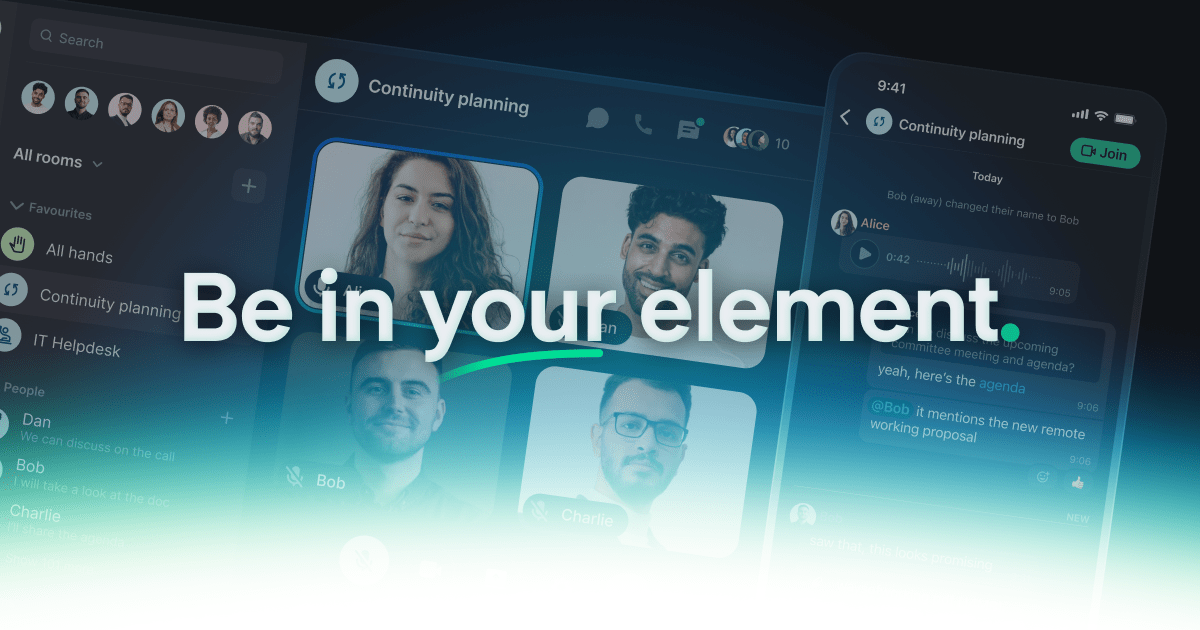
#4 Element United Kingdom Free self-hosted / from about €5/user/month (managed) Self-hosted, federated chat with bridges to other platforms
#5 HansaChat Germany Free for 10 users / from 99 EUR per month per workspace, flat Flat-price workspace chat when end-to-end encryption is not required

The 5 tools reviewed

#1 Wire

Zug, Switzerland Founded 2014 Free (personal) / SMB €7.45/user/month billed annually, €8.94 monthly Free personal tier

Best for: End-to-end encrypted teamwork with external guests and SSO

  • Operating company. Wire Swiss GmbH
  • Jurisdiction. Switzerland (adequacy decision, outside the EEA)
  • Where the data sits. EU (Germany, Ireland)
  • Independent checks. Open source
  • Source code. Open source
  • Replaces. Slack, Microsoft Teams, Zoom

Wire, operated by Wire Swiss GmbH in Zug, encrypts messages, calls, files and screen shares end to end with its Proteus protocol, and the code is open source on GitHub under the GPLv3. Independent audits, including by Kudelski Security and X41 D-Sec, are published. For business use the distinctive piece is Guest Rooms: a client or contractor joins a conversation from a browser link and keeps the same encryption without creating an account.

Administration scales with the plan. The Pro tier starts at €7.45 per user per month billed annually (€8.94 monthly) with guest rooms and admin controls, and Enterprise adds SAML 2.0 single sign-on, device management and data retention settings on request pricing. Servers are in Germany and Ireland, and Wire Server licensing exists for on-premises installs. Integrations are thinner than at Slack, and the Swiss registered office means transfers rest on the adequacy decision.

What Wire does well

  • End-to-end encryption on messages, calls, files and screen shares
  • Guest rooms for external contacts without accounts
  • Open source with published third-party audits

Where Wire falls short

  • Enterprise features such as SSO are priced on request
  • Fewer integrations than Slack or Teams

Standout feature. External guests join an encrypted conversation from a browser, no account needed.

#2 Threema

Pfaffikon, Switzerland Founded 2012 CHF 4.99 one-time (mobile) / CHF 2/user/month (Work) One-time purchase, no subscription

Best for: Anonymous identities and a cheap Work plan with on-prem option

  • Operating company. Threema AG
  • Jurisdiction. Switzerland (adequacy decision, outside the EEA)
  • Where the data sits. Switzerland
  • Independent checks. Open source, independently audited
  • Source code. Open source
  • Replaces. WhatsApp, Telegram, Signal

Threema, from Threema AG in Pfaffikon, encrypts every message, call, group chat and file end to end with the NaCl library and requires no phone number: users get a random Threema ID. The client apps are open source under the AGPLv3, and an independent audit by Cure53 has been published. Hosting is in Switzerland, which has an EU adequacy decision but sits outside the EEA.

The business edition, Threema Work, costs CHF 2 per user per month and adds administrative controls, device management and integration options. Threema OnPrem lets a large organisation run the whole infrastructure itself. Groups hold up to 256 members, and the verification dots show how sure you can be of a contact. The price of this design is a smaller user base and fewer integrations than mainstream tools, and the server code stays proprietary.

What Threema does well

  • No phone number or email needed for accounts
  • Work plan at CHF 2 per user per month
  • OnPrem option for self-hosting the full stack

Where Threema falls short

  • Server code is not open source
  • Smaller contact base and fewer integrations

Standout feature. The lowest per-user business price in this ranking, with an on-premises edition above it.

#3 Olvid

Paris, France Founded 2019 Free / Pro €4.99/user/month incl. tax (in-app) / Business €9.90/user/month excl. tax / Enterprise €9.90/user/month + €4,990/year Free tier; 1-month free trial of the in-app Pro option

Best for: Directory-free messaging certified by the French state agency

  • Operating company. Olvid SAS
  • Jurisdiction. EU (France)
  • Where the data sits. Amazon Web Services (AWS), region not stated by Olvid; the server only relays encrypted payloads
  • Independent checks. ANSSI CSPN security visas (iOS and Android apps)
  • Source code. Open source
  • Replaces. WhatsApp, Signal, Microsoft Teams chat

Olvid, made by Olvid SAS in Paris, keeps no central user directory and needs no phone number, so an account cannot be looked up by a stranger. The Android and iOS apps are open source under the AGPL-3.0, the distribution server code is published too, and ANSSI has granted CSPN security visas to the iOS and Android apps. The vendor says its server only relays encrypted payloads.

Plans run from free through an in-app Pro option at €4.99 per user per month including tax and Business at €9.90 per user per month excluding tax, to Enterprise at €9.90 per user per month plus €4,990 a year, which adds SSO and MDM.

The caveat is hosting: Olvid names Amazon Web Services without stating a region, so a procurement rule that reaches the subprocessor needs a direct question to Olvid. Contacts also have to be added deliberately, as there is nothing to search.

What Olvid does well

  • ANSSI CSPN visas on the mobile apps
  • Open source apps and published server code
  • SSO and MDM available on Enterprise

Where Olvid falls short

  • Hosted on AWS with the region not stated
  • Enterprise adds €4,990 a year to the per-user price

Standout feature. Certification applies to the app itself, where the encryption happens.

#4 Element

London, United Kingdom Founded 2016 Free self-hosted / from about €5/user/month (managed) Free self-hosted

Best for: Self-hosted, federated chat with bridges to other platforms

  • Operating company. Element (New Vector Ltd)
  • Jurisdiction. United Kingdom (adequacy decision, outside the EEA)
  • Where the data sits. Self-hosted, or European managed options
  • Independent checks. Open source, Matrix protocol
  • Source code. Open source
  • Replaces. Slack, Microsoft Teams, Discord

Element, from Element (New Vector Ltd) in London, is the main client for the open Matrix protocol. Encryption uses Olm and Megolm, based on the Signal double ratchet, and is on by default for private rooms and direct messages. Because Matrix is federated, an organisation can run its own homeserver for free, or take Element Cloud from about €5 per user per month, with European hosting options.

The administrative side depends on the tier: Professional and Enterprise add single sign-on, compliance tools and priority support, with custom pricing for large deployments. Bridges connect rooms to Slack, Telegram, WhatsApp and others, which softens a migration. Expect a steeper learning curve, occasional federation delays and key backup tasks that non-technical users find confusing. The company is in the United Kingdom, an adequacy-decision country outside the EEA.

What Element does well

  • Free self-hosting on an open protocol
  • Encryption on by default for private conversations
  • Bridges to other chat platforms

Where Element falls short

  • Key management and device verification confuse casual users
  • Large self-hosted deployments need careful capacity planning

Standout feature. You can leave Element the company and keep your Matrix server and data.

#5 HansaChat

Lübeck, Germany Founded 2024 Free for 10 users / from 99 EUR per month per workspace, flat Free for 10 users

Best for: Flat-price workspace chat when end-to-end encryption is not required

  • Operating company. HansaChat (sole operator)
  • Jurisdiction. EU (Germany)
  • Where the data sits. IONOS Cloud, EU
  • Independent checks. DPA under Art. 28 GDPR
  • Source code. Closed source
  • Replaces. Slack, Microsoft Teams, Google Chat

HansaChat, a workspace chat built and run from Lübeck by a sole operator, states its position on encryption directly: connections use HTTPS and TLS, files are encrypted at rest with AES-256, and the operator can technically access workspace data for maintenance, security and support. It is therefore a hosted workspace, not a zero-knowledge one. Admins and owners cannot read private channels or direct messages unless they are members.

Administration is lighter than at the others: two-factor authentication for accounts, single sign-on through Google and incoming webhooks.

The pricing is the draw: free for 10 users, then €99 per month for a workspace of up to 100 users on annual billing, or €109 billed monthly. Data sits on IONOS Cloud in the EU, with encrypted backups also stored in Sweden and the UK. No independent certification or penetration test report is published, and the imprint names an individual rather than a company.

What HansaChat does well

  • Flat workspace price instead of per-seat billing
  • Plain statement of what the operator can access
  • Separate database per paid workspace

Where HansaChat falls short

  • Not end-to-end encrypted, operator can access content
  • Sole operator and no published certification or audit

Standout feature. It tells buyers exactly where its encryption stops.

What should you check before trusting a messenger with company data?

Ask four questions: is content end-to-end encrypted by default, who holds the keys, which metadata remains with the operator, and what can an administrator see. Wire, Threema, Olvid and Element answer the first two in their favour; HansaChat answers them honestly in the other direction. Honest wording is a better sign than a trust badge.

Then check the proof. Threema has a published Cure53 audit, Wire lists Kudelski Security and X41 D-Sec, and Olvid holds ANSSI visas. For Element and HansaChat the proof is the open protocol and the plain security page respectively, not a certificate.

Which admin features matter in practice?

Start with identity: single sign-on, directory integration and a way to remove a leaver from every device on the day they go. Wire Enterprise lists SAML 2.0 and device management, Olvid Enterprise lists SSO and MDM, and Threema Work lists device management.

Then look at retention and external collaboration. Wire offers retention settings and guest rooms; HansaChat offers channel rules that block admin access to private chats. If an auditor will ask for message archives, remember that end-to-end encryption makes a central archive harder, so decide which matters more.

Should you self-host?

Self-hosting makes sense when the policy demands that no third party holds the data: Element can run on your own homeserver at no licence cost, Threema offers OnPrem and Wire offers Wire Server licensing. It also means you run updates, backups and monitoring.

For a company without an operations team, a managed plan is the realistic route: Element Cloud from about €5 per user per month, Wire Pro from €7.45, Threema Work at CHF 2, Olvid Business at €9.90. Compare these in the same currency before deciding, since Threema bills in Swiss francs.

How do you migrate a team off WhatsApp or Teams chat?

Pick one use case first, such as client groups or an incident channel, and move that completely. Element bridges help when half the company stays on Slack or Telegram for a while, while Wire guest rooms help when clients refuse to install anything.

Write the rule that business content stays out of the old tool, and give managers the new tool first. A messenger with a small user base needs that push, because people follow their contacts.

When is end-to-end encryption not worth it?

If you need server-side search across all conversations, central archiving for regulated records, or a bot that reads channels, a hosted workspace such as HansaChat may fit better. The cost is that the operator can access content, so the legal and contract layer (a data processing agreement, EU hosting) carries the protection.

Decide by data class: sensitive client or personnel content in an end-to-end encrypted tool, routine coordination in the workspace tool. Two tools cost more attention but match the risk.

How we selected and ranked these 5 tools

Every tool on this page is in the European Purpose directory, which means the operating company is established in Europe and we have verified that from the company register or the vendor's own legal notice rather than from a marketing page. Tools headquartered outside Europe are not eligible, however good they are.

  1. Feature verification (weight: 40%). We check each capability against the vendor's own documentation and product pages, and record what the tool does rather than what the category is assumed to include.
  2. Ease of adoption (weight: 30%). Integrations, published API access, trial availability and how much configuration stands between signing and a usable result.
  3. Value and transparency (weight: 30%). Published pricing counts in a vendor's favour; quote-only pricing is recorded as quote-only rather than estimated. We weigh what a buyer gets for the entry price, not the headline feature count.
  4. Editorial review. Every page is researched and drafted with AI assistance, and the compliance and pricing claims are checked against the vendor's documentation before it is published under the founder's editorial responsibility. The three weights above decide the order; a position is a ranking against the other European tools in this category, not an absolute score.

Vendor-reported outcomes — ROI figures, margin uplift, time saved — are labelled as vendor claims wherever they appear on this page. We have not audited them, and neither has anyone else who quotes them. Read our full editorial process for how pages are re-verified.

Frequently asked questions

Threema Work at CHF 2 per user per month. Olvid's in-app Pro option is €4.99 including tax, and Element Cloud starts at about €5 per user per month.

Wire, Threema (client apps), Olvid (apps and distribution server code) and Element are open source. HansaChat is not.

Wire states Germany and Ireland, and HansaChat states IONOS Cloud in the EU. Threema is in Switzerland, Olvid names AWS without a region, and Element depends on how you deploy it.

Their tool pages here state admin features and German hosting but no encryption model, so they do not meet this guide's criterion. Both are covered in the Messaging category.

Olvid has a free tier, Element can be self-hosted at no cost, HansaChat has a free 10-user workspace and Wire has a free personal plan. Threema is a one-time purchase on mobile.