Best European Alternatives to Microsoft Teams
Looking for a European alternative to Microsoft Teams? While Teams is popular for business, it's a US product subject to American data laws and part of Microsoft's ecosystem.
European collaboration platforms offer video conferencing with team features while keeping your data in Europe.

How we rank these tools — 4-step process
-
1
European ownership, verified
The company is headquartered and incorporated in the EU, EEA, the UK, Switzerland or Israel, and processes customer data in Europe or Israel. A US parent company disqualifies a tool from this page regardless of where its servers are.
-
2
Category fit and hands-on review
What the tool actually does, who it suits, and where it falls short — checked against the vendor’s own documentation, changelog and pricing page rather than its marketing copy.
-
3
Compliance and pricing check
GDPR posture, hosting location and the prices quoted on this page are verified against the vendor’s public pricing before publication, and re-checked when we revisit the category.
-
4
Position on this page
Placement on this page can be paid, and that can affect which tools appear here and the order they appear in. It never buys a good review: a tool that fails the checks above is not here at any price, and payment does not change the shortcomings we write about. A vendor can ask us to correct a factual error — not to remove a criticism.
Vendors can pay for visibility on this page. It never changes what an entry says about a product, including the criticism, and we earn nothing when you click through to a vendor. Paid placement can affect which tools appear here and the order they appear in. Editorial policy
12 European Alternatives to Microsoft Teams

Wire
End-to-end encrypted team communication
Element
Secure collaboration based on the Matrix protocol

Whereby
Simple video meetings with team rooms

Nextcloud Talk
Self-hosted video calls integrated with Nextcloud

Briar
European peer-to-peer messenger with Tor routing that works without internet - designed for activists and journalists

Delta Chat
Encrypted messenger built on email, so any email or chatmail server can carry it

ginlo
Munich messenger with a free private app and a managed business edition

HansaChat
German team chat billed per workspace instead of per user, hosted on IONOS Cloud in the EU - a Slack alternative for teams that grew tired of per-seat pricing

Olvid
French messenger with no phone number and no central directory, holding an ANSSI CSPN visa

Session
Decentralized messenger with no phone number required, onion routing, and community-run infrastructure - truly anonymous messaging

SimpleX Chat
UK-based messenger with no user identifiers - no phone numbers, no usernames, no accounts, just complete privacy

Balsio
A newly launched Latvian messaging app for professional communication - a European alternative to WhatsApp built around EU Digital Markets Act interoperability
Key takeaways
- The usual complaint does not apply here: for an EU or EFTA tenant, Microsoft stores and processes Microsoft 365 Customer Data inside the EU Data Boundary, and Teams is in scope.
- Teams end-to-end encryption covers meetings and one-to-one calls only. Chat messages and channel messages — the actual archive — are outside it.
- End-to-end encrypted meetings require a Teams Premium licence for the organiser, and enabling encryption disables recording, transcription, captions, breakout rooms, PowerPoint Live, PSTN dial-in and Copilot.
- Customers with Multi-Geo Capabilities fall outside the EU Data Boundary entirely, even when the tenant is listed in an EU country.
- Teams has never had an on-premises edition; the on-premises line it replaced, Skype for Business Server 2019, left extended support on 14 October 2025.
Why people leave Microsoft Teams
Begin by throwing away the usual argument, because on this page it is false.
Microsoft has built the EU Data Boundary, and for a tenant whose sign-up location is in the EU or EFTA, Customer Data and personal data for Microsoft 365 — Teams included — are stored and processed in data centres inside that boundary. Microsoft names the countries, publishes the documentation and lists the exceptions. Very few American vendors have gone anywhere near this far, and a page telling you your chats are sitting in Virginia is simply wrong.
Two things survive that. The first is jurisdiction, which no amount of infrastructure changes: Microsoft Corporation is a company in Redmond, Washington, and the boundary documentation itself describes limited circumstances in which data continues to be transferred outside it. Customers who bought Multi-Geo Capabilities are excluded from the boundary altogether, even with a tenant listed in an EU country.
The second is what is actually encrypted, and this is the part most procurement reviews never reach. Teams end-to-end encryption covers meetings and one-to-one calls. It does not cover chat messages or channel messages, which is where the organisation's real archive lives.
Where it does apply, the meeting organiser needs a Teams Premium licence, one-to-one call encryption is off by default in the org-wide policy and has to be switched on by the user as well, and turning it on removes recording, transcription, live captions, breakout rooms, PowerPoint Live, Excel Live, phone dial-in and Copilot.
- The archive is never end-to-end encrypted Chat and channel messages are the corporate memory: the decision made in a thread, the salary discussed in a direct message, the incident nobody wrote up anywhere else. Teams protects them in transit and at rest with keys Microsoft manages, which is normal and also means the service can read them. End-to-end encryption in Teams applies to meetings and one-to-one calls and stops there. If your reason for looking is that a supplier should not be able to read the conversation, the feature that sounds like the answer does not cover the thing you were worried about.
- The encryption you can get is licensed, off by default and expensive to use A meeting organiser needs a Teams Premium licence to schedule an end-to-end encrypted meeting. One-to-one call encryption is disabled in the Global org-wide policy, and even once an administrator permits it the user has to enable it in their own settings. Switch it on and Microsoft's own table lists what stops working: recording, transcription, live captions, real-time text, call transfer, park and merge, adding a participant, breakout rooms, PowerPoint Live, Excel Live, large gallery, PSTN dial-in and Copilot. Web and virtual-desktop clients cannot join at all, and the ceiling is 200 participants. Anyone subject to compliance recording cannot use it.
- Teams was never a thing you could run yourself Microsoft 365 has an on-premises heritage that Teams does not share. Exchange had a server, SharePoint had a server, Skype for Business had a server — and Skype for Business Server 2019 left extended support on 14 October 2025. Teams has never had an on-premises edition and was not designed to have one. Microsoft did not abandon self-hosting wholesale, and it is worth saying so: Skype for Business Server Subscription Edition began on 1 July 2025 and is supported under the Modern Lifecycle Policy. It is simply not Teams, and it does not do what Teams does.
- Residency is a storage answer to a jurisdiction question The EU Data Boundary is a genuine engineering commitment and it answers a procurement question about where data lives. It does not answer a legal question about who can be compelled to produce it, because that follows the corporation rather than the rack. Microsoft documents the exceptions itself — limited circumstances in which data still leaves the boundary, and remote access by engineering staff under a pseudonymisation regime. If your risk assessment is about foreign disclosure orders, the honest conclusion is that no configuration inside Microsoft 365 addresses it.
What you have to replace, not just match
Teams is not one product and it is not even mostly a chat product. Work out which of its four jobs you are replacing before comparing anything, because the tools below divide up along exactly those lines.
The first is persistent chat: channels, threads and direct messages, the archive that has quietly become how the organisation remembers things. The second is meetings: scheduling, joining, screen sharing and the external participants who are not in your tenant. The third is the file and document layer, which is not Teams at all — a Teams channel is a view onto SharePoint, and its files live in SharePoint and OneDrive. The fourth is telephony, calling plans and phone numbers.
Wire and Element answer the first, from different directions. Whereby answers the second and is deliberately narrower than Teams. Nextcloud is the only entry here that touches the third, which matters because removing Teams alone leaves the tenant exactly where it was. Nothing on this page replaces the fourth, and an organisation running Teams Phone should treat that as a separate project with a separate supplier.
The alternatives compared
| Position | Tool | Headquarters | Pricing | Jurisdiction |
|---|---|---|---|---|
| #1 | Wire | Zug, Switzerland | Free (personal) / SMB €7.45/user/month billed annually, €8.94 monthly | Switzerland (adequacy decision, outside the EEA) |
| #2 | Element | London, United Kingdom | Free self-hosted / from about €5/user/month (managed) | United Kingdom (adequacy decision, outside the EEA) |
| #3 | Whereby | Oslo, Norway | Free (1 room, 45 min) / from €6.99/month per host | EEA, not EU (Norway) |
| #4 | Nextcloud | Stuttgart, Germany | Free self-hosted / Enterprise plans on request | EU (Germany) |
How each alternative compares to Microsoft Teams
- Which law reaches it. Switzerland (adequacy decision, outside the EEA). Microsoft Teams is run from the United States, so the CLOUD Act obliges the provider to hand over data on a valid order regardless of which country the servers are in.
- Where the data sits. EU (Germany, Ireland).
- Source code. Open source, where Microsoft Teams is not: you can read what it does rather than take the description on trust.
Best for: Organisations that assumed Teams encryption covered the chat and discovered it does not
The single clearest contrast on this page is between two encryption models.
In Teams, end-to-end encryption is a mode: available for meetings if the organiser holds Teams Premium, available for one-to-one calls if an administrator permits it and the user enables it, and never available for chat or channel messages. In Wire it is the condition the product ships in. Messages, calls and files are end-to-end encrypted for everyone on every plan, and there is no upgrade path to buy because there is nothing switched off.
That changes what you give up. Microsoft documents a long list of features that stop working once Teams encryption is on, including recording, transcription, captions, breakout rooms, PowerPoint Live and dial-in.
Wire never had a service-side transcription business to lose, so its encrypted video conferences — up to 150 participants on the paid business plan — come with encrypted screen sharing rather than with a list of exclusions. Guest Rooms handle the external participant properly: a client or contractor opens a link in a browser, with no account and no installation, and stays inside the same encryption as everyone else.
Wire Swiss GmbH is registered in Zug with processing in EU data centres in Germany and Ireland, and the platform is open source, running Proteus for messages alongside MLS across messages, calls and files.
What you lose against Teams is everything that was never chat: no SharePoint layer, no Office documents, no telephony, and an integration catalogue that is small next to Microsoft's.
Wire for SMB is listed at €7.45 per person per month billed annually, or €8.94 billed monthly, with a free tier for up to five people beneath it and custom pricing above. There have been questions about the ownership structure since it took venture funding, which Wire has addressed publicly and the open code lets the community keep checking.
What Wire does better than Microsoft Teams
- Messages, calls and files are encrypted end to end by default, where Teams leaves chat and channel messages outside encryption entirely
- No premium licence needed to encrypt a meeting, and no list of features that stop working when you do
- A Swiss operating company with processing in Germany and Ireland, so no US corporation holds the archive
- Guest Rooms give an external party encrypted access from a browser with no account and no tenant
- Open source, so the encryption claim can be read rather than taken on the vendor's word
Where Wire is a step down from Microsoft Teams
- No document layer at all: SharePoint, OneDrive and Office have no counterpart here
- No telephony, so an organisation on Teams Phone still needs a phone system
- The integration catalogue is a fraction of Microsoft's, with no equivalent app marketplace
- Encryption means no service-side transcription, captions or meeting summaries, which some teams now depend on
- Cloud only, so an organisation wanting its own servers has to look further down this page
Standout against Microsoft Teams. It is the only entry here where encrypting a meeting costs you nothing — no licence tier, and none of the eighteen features Microsoft tabulates as unavailable once Teams encryption is enabled.
- Which law reaches it. United Kingdom (adequacy decision, outside the EEA). Microsoft Teams is run from the United States, so the CLOUD Act obliges the provider to hand over data on a valid order regardless of which country the servers are in.
- Where the data sits. Self-hosted, or European managed options.
- Source code. Open source, where Microsoft Teams is not: you can read what it does rather than take the description on trust.
Best for: Organisations that want the platform on their own infrastructure, not in someone's boundary
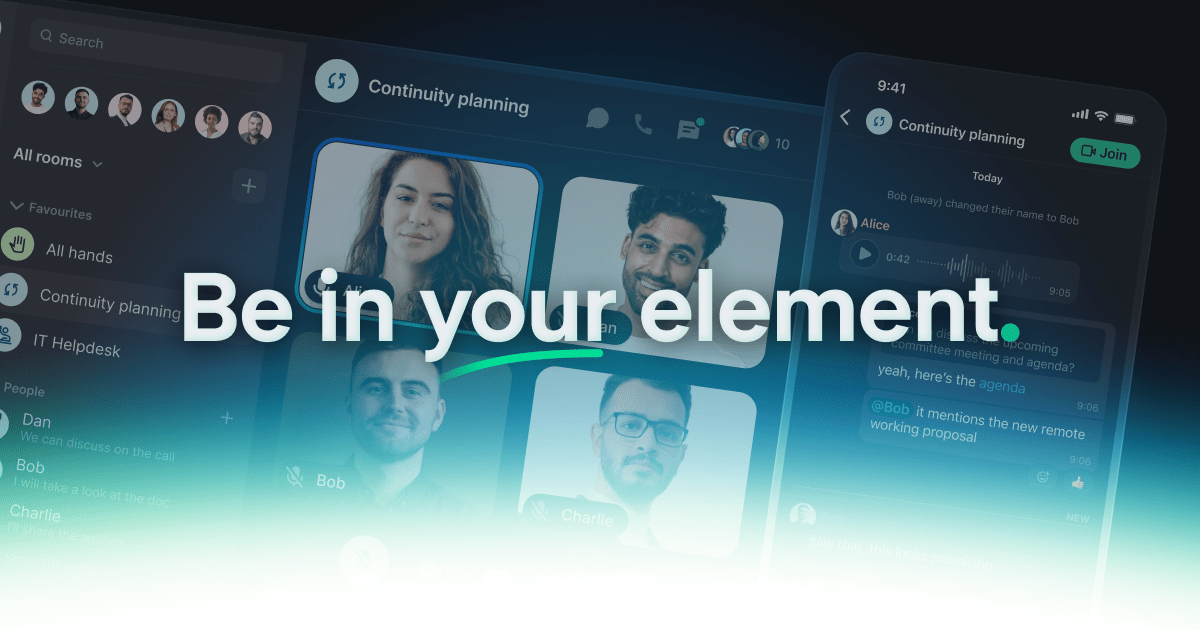
Everything else in the Microsoft 365 lineage had a server you could install. Exchange did, SharePoint did, and Skype for Business Server 2019 did until extended support ended on 14 October 2025. Teams never did. Element, built on the open Matrix protocol, is the closest thing on the market to that missing product: an organisation runs its own homeserver, holds the accounts, sets the retention and decides where the machine sits.
The federation model is the part that has no Teams equivalent. Two organisations running their own Matrix servers can put people in the same room without either side issuing a guest account in its tenant, which is how a ministry talks to an agency, or a hospital to a supplier, without one of them becoming a tenant of the other.
That property is why Matrix keeps appearing in European public-sector deployments where a SaaS product could not qualify at all. Bridges to other platforms let an organisation move in stages rather than by decree.
It asks more of you than anything else here. Synapse is resource-intensive and needs deliberate infrastructure planning as user counts grow, federation can delay delivery, and cross-device key verification is a genuine support burden among people who have never met the concept.
Element (New Vector Ltd) is in London, outside the EEA under a UK adequacy decision, which is an argument for running your own homeserver rather than against the software. Managed European hosting starts at about €5 per user per month, and self-hosting has no licence cost at all.
What Element does better than Microsoft Teams
- Runs on your own hardware, which Teams has never allowed at any price
- Federation lets two organisations share a room without either issuing guest accounts in its tenant
- End-to-end encryption applies to the written archive, which Teams encryption does not cover
- Open source on an open protocol, so nothing about the deployment depends on one vendor surviving
- Retention, logging and data location are your configuration rather than a supplier's published commitment
Where Element is a step down from Microsoft Teams
- Somebody has to run Synapse, and at scale that is a real infrastructure job
- Key verification and encrypted-history recovery generate support tickets that Teams never produced
- No document editing, no spreadsheet co-authoring and no equivalent of the Office integration
- The vendor is in London rather than the EU, so self-hosting is what answers the jurisdiction question
- Bridges to Teams inherit the limits of Microsoft's API and are something else to operate
Standout against Microsoft Teams. It is the only option here that two separate organisations can federate between as equals, which is the arrangement Teams replaces with a guest account inside somebody's tenant.
- Which law reaches it. EEA, not EU (Norway). Microsoft Teams is run from the United States, so the CLOUD Act obliges the provider to hand over data on a valid order regardless of which country the servers are in.
- Where the data sits. Europe and global.
- Source code. Closed source, as Microsoft Teams is.
- Independently checked. HIPAA compliant (Embedded).
Best for: Teams whose Teams problem is external meetings rather than internal chat
A large proportion of the friction people blame on Teams is not internal. It is the client, the candidate, the supplier and the regulator — people with no account in your tenant, who get an invitation, an install prompt, a browser experience with features missing, and a lobby. Whereby removes all of it: the call runs in the browser over WebRTC and the guest joins by clicking a link, with nothing to install and no account to create.
The second property is the room that does not change. A host keeps a permanent URL rather than generating a fresh meeting link each time, which turns a recurring external meeting into an address you can put on a contract or a website.
Whereby AS operates from Oslo, which is inside the EEA with the GDPR applying in full, and Norway sits inside the EU Data Boundary's own list of EFTA countries, so this is not a step outside the perimeter Microsoft drew. There is also an embedded edition, billed by the participant minute, that carries HIPAA compliance alongside the GDPR position for organisations putting video into their own software.
Judge it as a meeting tool and nothing else, because that is what it is. There is no persistent chat, no channels and no file store, so it replaces one of Teams' four jobs and leaves the others untouched.
It is built for meetings up to 200 participants rather than for large webinars, SSO and detailed analytics sit on higher tiers, and quality depends on the guest's browser and hardware.
Price it honestly before you plan around it: the free tier is a single room URL for four attendees and thirty minutes, Pro is $10.99 per host per month for 100 participants with no time limit, and Business is $13.99 per host per month with a three-host minimum, unlimited room URLs and a 200-participant ceiling.
What Whereby does better than Microsoft Teams
- External guests join in a browser with no account and no install, where Teams pushes them towards an app and a lobby
- A permanent room URL that can be printed, instead of a link regenerated for every meeting
- A Norwegian company inside the EEA, with no US parent behind the service
- Priced per host rather than per employee, so meetings with outsiders do not scale the invoice with headcount
- An embeddable version with HIPAA and GDPR compliance for putting video inside your own product
Where Whereby is a step down from Microsoft Teams
- No persistent chat, no channels and no file storage, so it replaces one part of Teams and nothing else
- Built for meetings up to about 200 participants, not for large webinars or all-hands events
- Call quality tracks the participant's browser and hardware, and older machines struggle in big calls
- SSO and detailed analytics only appear on the higher tiers
- A much smaller integration ecosystem than Teams, and no telephony
Standout against Microsoft Teams. It is the only entry here that asks nothing whatsoever of the person you are meeting, which is the requirement Teams imposes on every outsider it touches.
- Which law reaches it. EU (Germany). Microsoft Teams is run from the United States, so the CLOUD Act obliges the provider to hand over data on a valid order regardless of which country the servers are in.
- Where the data sits. Wherever you host it.
- Source code. Open source, where Microsoft Teams is not: you can read what it does rather than take the description on trust.
Best for: Organisations that realise Teams is a window onto SharePoint and OneDrive
Teams looks like a chat product and is largely an interface. Channel files live in a SharePoint document library, chat attachments live in the sender's OneDrive, and the calendar is Exchange. Replace Teams alone and every one of those stays inside Microsoft 365, which means the subscription continues, the jurisdiction question is unchanged, and the organisation now has two places to look for a document. Nextcloud is the only entry on this page that takes that problem seriously.
Nextcloud GmbH is in Stuttgart, the software is AGPL-licensed, and a single installation covers files, calendar, contacts, collaborative document editing and Talk for chat and calls.
Run it on your own hardware and there is no provider to compel, no boundary to verify and no exception list to read: the retention policy is yours, the logs are yours, and the data location is the address of the building. That is a categorically different answer from a supplier commitment, however well documented.
It is also the biggest undertaking here and it should be described as one. Talk is a weaker chat product than Wire or Element and nobody should pretend otherwise, the document editing is capable rather than equal to Office, and somebody has to own updates, backups and uptime.
For most organisations the sane route is managed Nextcloud hosting from a European provider rather than a server in a cupboard. Consider it when Teams is not the only thing you are replacing, because migrating chat, files and calendars together is often less work than three separate projects.
What Nextcloud does better than Microsoft Teams
- Covers files, calendar, contacts, documents and chat in one system, where moving off Teams alone leaves all of that in Microsoft 365
- Runs on your own infrastructure, so there is no provider commitment to verify and no exception list to read
- AGPL-licensed, so the code can be audited instead of trusted
- A German company with no US parent anywhere in the ownership chain
- No per-seat licence when self-hosted, so cost scales with hardware rather than headcount
Where Nextcloud is a step down from Microsoft Teams
- Talk is a thinner chat and meeting product than Wire or Element
- Document editing is competent but not a match for Office co-authoring
- Someone has to own the installation, the upgrades, the backups and the uptime
- Migrating files, permissions and calendars alongside the chat makes this a project rather than a switch
- No telephony, so Teams Phone still needs replacing separately
Standout against Microsoft Teams. It is the only option here that answers the part of Teams that is not Teams at all: the SharePoint libraries and OneDrive folders every channel is quietly built on.
What actually breaks when you switch
The files are the migration. A Teams channel is a view onto a SharePoint document library and a chat attachment sits in the sender's OneDrive, so moving conversations moves almost nothing of substance. Inventory where the documents actually live and who has permission to them before choosing a destination, because that inventory decides whether this is a chat migration or a workspace migration.
Then count the things that only work because the service reads the content. Automatic transcription, live captions, recorded meetings that get summarised, Copilot output somebody has started quoting in reports: an encrypted product cannot provide any of them, and Microsoft's own encryption documentation says as much about Teams itself. Decide which of those habits the organisation will actually give up, and get that decision in writing before the pilot rather than after it.
Finally, the phone system is not in scope and should not be smuggled in. Teams Phone with calling plans, numbers, auto-attendants and emergency calling is a telecoms procurement, and no product on this page replaces it. Organisations that treat it as an afterthought discover halfway through a cutover that the switchboard is the blocker.
If Microsoft keeps my data in Europe, what is left to worry about?
Two separate things, and it is worth keeping them apart because they have different answers. Where the data is stored is settled: the EU Data Boundary covers Customer Data and personal data for Microsoft 365 in EU and EFTA data centres, with the service documentation naming the countries. If your requirement came from a procurement rule about storage location, Microsoft satisfies it and you can stop reading.
Who can be compelled to produce the data is not settled by geography, because that obligation attaches to the corporation. Microsoft also documents the exceptions itself: limited circumstances in which data continues to be transferred outside the boundary, and remote access by staff working under a pseudonymisation regime. Neither of those is a scandal. Both mean the boundary is a commitment about handling rather than a wall.
And check whether you are inside it at all. An organisation that bought Multi-Geo Capabilities is out of scope for the EU Data Boundary even with an EU tenant, which is exactly the kind of detail that surfaces during an audit rather than during a purchase.
Can I turn on end-to-end encryption in Teams and be done?
Only for a narrow slice, and at a price in functionality that most organisations decline once they see it. Encryption applies to meetings and one-to-one calls. Chat threads and channel messages are not covered at all, so the written record — which is the part a leak, a subpoena or a curious administrator would actually want — stays readable to the service.
For meetings, the organiser needs a Teams Premium licence. For one-to-one calls the setting is disabled in the org-wide policy by default and the user must also enable it on their device. Once enabled, Microsoft's documentation lists what becomes unavailable: recording and transcription, live captions, real-time text, call transfer, park and merge, adding a participant mid-call, breakout rooms, PowerPoint Live, Excel Live, large gallery, dial-in by phone and Copilot.
There are practical ceilings too. Encrypted meetings are capped at 200 participants, web and virtual-desktop clients are blocked from joining, and anybody subject to compliance recording cannot use the feature at all. The realistic conclusion is that Teams encryption is a mode for one sensitive call, not a posture for an organisation.
Which of these can we actually run on our own infrastructure?
Element and Nextcloud, properly and at any scale you are willing to operate. Element is the client for Matrix, and an organisation runs its own homeserver, holds the accounts and sets its own retention. Nextcloud is AGPL-licensed and installs on your own hardware, bringing files, calendar, contacts and Talk with it. Both are the on-premises collaboration platform Teams has never been.
Wire is a hosted product, with processing in EU data centres in Germany and Ireland, and Whereby is a Norwegian cloud service. For an organisation whose objection is jurisdiction rather than physical control, either is enough, and for one whose objection is that a third party holds anything at all, neither is.
Be honest about the operating cost. A Matrix homeserver or a Nextcloud installation needs an owner, a patch schedule and a backup regime, which is the work you are currently buying from Microsoft. Managed European hosting exists for both and is the sensible middle route for an organisation that wants the jurisdiction without the pager.
What will people miss most in the first month?
The file layer, and they will not describe it that way. They will say a document has gone missing. A Teams channel is a view onto a SharePoint document library, so the conversation and the file have always been two systems wearing one interface. Move the chat and the files stay in the tenant, which means you are paying for Microsoft 365 anyway and have added a second place to look.
Second, the meeting habits that depend on the service reading the content: recordings that transcribe automatically, live captions, and the Copilot summary somebody has started relying on. Those are not missing from European tools by accident. They require the provider to process the media, which is precisely the access an encrypted product refuses to have.
Third, telephony. Organisations running Teams Phone with calling plans and real numbers are running a phone system, not a chat tool, and nothing on this page replaces it. That migration is a separate procurement with a separate supplier and it should be planned as one.
Which one to pick
If your requirement is that the supplier cannot read the conversation, Wire is the answer on this page, because encryption is how the product ships rather than a licence tier with a list of disabled features attached to it.
If your requirement is that the platform runs on infrastructure you control, Element is the collaboration server Teams never offered, and federation means a partner organisation can join the room without becoming a guest in your tenant.
If the friction you feel is really about meetings with people outside the organisation, Whereby removes it entirely and does not pretend to replace anything else.
And if you have understood that Teams is a window onto SharePoint and OneDrive, Nextcloud is the only entry that addresses what is behind the glass. If you take none of these, at least confirm your tenant is inside the EU Data Boundary and that nobody bought Multi-Geo Capabilities, because that assumption is the one most likely to be wrong.
Frequently Asked Questions
Wire if the requirement is that the supplier cannot read the conversation, because it encrypts messages, calls and files by default rather than as a licensed mode.
Element if you want the collaboration server on your own infrastructure, which Teams has never offered. Whereby if what you are really replacing is meetings with people outside the organisation. Nextcloud if you are replacing the tenant rather than the chat client. The answer depends on which of Teams' four jobs you are moving.
Yes, for tenants with a sign-up location in the EU or EFTA.
Under the EU Data Boundary, Microsoft commits to storing and processing Customer Data and personal data for Microsoft 365 in data centres inside the EU and EFTA, and Professional Services Data at rest there. The documented exceptions are limited circumstances in which data still transfers outside, and remote access by Microsoft staff to pseudonymised logs. Customers who bought Multi-Geo Capabilities are out of scope even with an EU tenant.
Partly, and the boundary is precise. End-to-end encryption is available for meetings and for one-to-one calls. Chat messages and channel messages are not end-to-end encrypted at all. Encrypted meetings require the organiser to hold a Teams Premium licence, and one-to-one call encryption is disabled by default in the org-wide policy and must also be switched on by the user.
Microsoft publishes the list. Recording, transcription and live captions become unavailable, along with real-time text, call transfer, call park, call merge, adding a participant, breakout rooms, PowerPoint Live, Excel Live, large gallery and companion mode, dial-in by phone, and Copilot in meetings. Web and virtual-desktop clients cannot join an encrypted meeting, the participant ceiling is 200, and a user subject to compliance recording cannot use the feature at all.
No. Teams has never had an on-premises edition and was not designed for one. The on-premises product it replaced, Skype for Business Server 2019, left extended support on 14 October 2025. Microsoft has not abandoned on-premises communication entirely — Skype for Business Server Subscription Edition started on 1 July 2025 and remains supported under the Modern Lifecycle Policy — but it is a different product with a different feature set, and it is not a way to self-host Teams.
No, and this is the step most migrations underestimate. Files shared in a Teams channel live in a SharePoint document library, and files shared in a chat live in the sender's OneDrive. Moving the conversation to another product leaves both behind, along with the permissions attached to them. Either plan the file migration as part of the same project, or accept that you are keeping the Microsoft 365 subscription and have added a second place to look for things.
Not reliably, and the comparison is usually the wrong shape. Teams is bought as part of a Microsoft 365 subscription that also supplies mail, documents and storage, so a per-seat comparison against a standalone chat tool flatters the alternative.
Element and Nextcloud can be free of licence cost when self-hosted, with an administrator as the real expense. The saving that is genuine, when there is one, comes from dropping a Teams Premium tier bought for features an encrypted product does not need.
Yes, with different amounts of effort. Element can bridge Matrix rooms to other platforms, which lets an organisation move in stages rather than on a single announced date, at the cost of running and maintaining the bridge.
Whereby needs nothing from the other party at all, because guests join a meeting in a browser. Wire's Guest Rooms bring an outsider into an encrypted conversation from a browser with no account. What none of them does is appear inside somebody else's Teams client, so expect to keep a Teams account for federated external work for a while.
Only if you move to a supplier with no US parent, and then only for what you actually move.
A German or Swiss provider has no obligation under a US disclosure order, and a server you run yourself has no provider to receive one. But if the chat moves and SharePoint, Exchange and OneDrive stay, the majority of your organisation's content is still held by Microsoft Corporation and the position is largely unchanged. Decide whether you are answering the question or relocating it.
Related comparisons
European tools head to head
About the author
Explore More European Alternatives
Discover privacy-focused European alternatives to other popular US tech services.