Every European translation service reviewed
Cologne, Germany
Founded 2017
Free tier / from about €8.99/month
Free tier
Best for: Professionals who need accurate translation with the right register
DeepL is better than Google Translate on European language pairs, and the difference is not marginal where it matters.
German compound nouns and separable verbs, French register and agreement, Dutch word order — these are the constructions where word-order translation produces something comprehensible and unmistakably machine-made, and where DeepL produces something a native speaker might have written. The practical test is register: both engines convey the meaning, but DeepL preserves whether the original was formal or casual, which decides whether the output can go into a business email unedited.
DeepL SE operates from Cologne with EU processing, covering more than 30 languages with document translation that preserves formatting, an API for building translation into a product, and a glossary that enforces terminology across every document — the feature that turns DeepL from a tool into infrastructure for a company with technical or regulated content.
DeepL Write applies the same engine to improving text within one language, competing with Grammarly from a GDPR jurisdiction. Free tier available with paid plans from about €8.99 per month, and the paid plans carry the commitment not to retain text after translation, which is the clause a legal or medical team needs.
What DeepL does well
- Noticeably better than Google Translate on European language pairs
- Preserves register, so output is usable without rewriting
- Glossary enforces consistent terminology across documents
- Paid plans commit to not retaining text after translation
- German company, EU processing, document translation and API
Where DeepL falls short
- Fewer languages than Google Translate
- Free tier lacks the non-retention commitment
- Not open source
- Weaker on languages outside the European core
Standout feature. Register that survives: DeepL is the only engine here whose output reliably keeps the formality of the original, which is what makes it usable without a rewrite.
Paris, France
Founded 1998
Free tier / Premium from about €6.99/month
Free tier
Best for: Language learners and people writing in a second language
Reverso answers the question a translator cannot: not what this sentence means, but whether this is how people actually say it. Reverso Context shows real-world usage examples drawn from bilingual material, so you can see a phrase used in its natural setting rather than only in isolation — which is the difference between a technically correct sentence and one a native speaker would produce.
Around that sit the tools a learner actually needs: conjugation tables covering the irregular verbs that break every attempt at a Romance or Germanic language, a bilingual dictionary, a grammar checker and a writing assistant for producing text rather than only reading it.
Mobile apps and browser extensions put it where the writing happens. Reverso operates from Paris under EU jurisdiction with intra-EEA processing. Free tier with Premium from about €6.99 per month. The limits: raw translation quality is below DeepL's, the corpus is smaller than Linguee's, and it is not open source.
What Reverso does well
- Reverso Context shows how phrases are actually used
- Conjugation tables, dictionary and grammar checker together
- Writing assistant for producing rather than only reading
- Mobile apps and browser extensions
- French company, EU jurisdiction, free tier available
Where Reverso falls short
- Raw translation quality below DeepL
- Corpus smaller than Linguee's
- Not open source
- Premium needed for the full feature set
Standout feature. Conjugation next to context: Reverso is the only tool here that answers both "how do I form this verb" and "would anyone actually say it".
Maidenhead, United Kingdom
Founded 1984
From about €155/year
Free trial
Best for: Professional translators and agencies working at volume
Trados is the industry standard for professional translation, and translation memory is why.
Every segment a translator completes is stored with its approved translation, so when a similar sentence appears in the next project — the updated manual, the next contract from the same client, the new release notes — it is proposed rather than retranslated. For repetitive technical content that is the entire economics of the profession: a 200-page manual updated annually is perhaps 15% new text, and without a memory it is 100% billable work every year.
Trados has been building this since 1984, which is longer than most of the software on this site has existed.
Alongside memory sits terminology management, ensuring an agreed term renders identically across a project and across translators — critical in regulated content where a wrong word is a compliance failure rather than a stylistic one.
Machine translation integration lets an engine like DeepL or ModernMT pre-fill segments for the translator to correct. Trados Studio runs on the desktop with the memory local; Trados Go provides browser-based work. From about €155 per year, operating from Maidenhead in the UK under an adequacy decision. It is a professional tool with a professional learning curve, and entirely the wrong purchase for a company translating its website once.
What Trados does well
- Translation memory turns repetitive content into economics that work
- Terminology management enforces consistency across teams
- Machine translation integration for pre-filling segments
- Desktop Studio with local memory, plus browser-based Trados Go
- Industry standard since 1984 with project management built in
Where Trados falls short
- Steep learning curve; a professional tool for professionals
- From about €155/year, wrong purchase for occasional translation
- UK company, so adequacy rather than EU establishment
- Interface shows its long history
Standout feature. Four decades of translation memory: Trados is the only tool here where the work you did in 2015 makes the project you start today cheaper.
Cologne, Germany
Founded 2009
Free
Free
Best for: Checking how a phrase is actually translated in practice
Linguee is not a translator, and that is the point. It is a search engine over a corpus of real bilingual documents — official EU texts, company websites, published translations — showing how a phrase was actually rendered by human translators, with the source visible so you can judge whether the context matches yours.
That answers a different question from any translation engine. A translator tells you what a sentence means; Linguee tells you what people actually wrote when they meant that, which is what you need when producing text rather than consuming it. For legal, technical and official language it is especially strong, because EU documents are professionally translated into every member language and form a large, high-quality parallel corpus.
Linguee comes from the same Cologne company as DeepL, operating under EU jurisdiction, and it is completely free. The limits follow from the design: Linguee will not translate your sentence, coverage depends on the phrase appearing in the corpus so rare or very new terms return nothing, and the examples require judgement — a translation in the corpus is what someone did, not necessarily what was right.
What Linguee does well
- Shows how phrases were actually translated by humans, in context
- Sources visible so you can judge whether the context matches
- Especially strong on legal, technical and official language
- Completely free, from the same company as DeepL
- German company under EU jurisdiction
Where Linguee falls short
- Does not translate your sentence — it is reference, not a translator
- Rare or very new terms return nothing
- Examples require judgement; a corpus entry is not a verdict
- Not open source
Standout feature. Real human translations as evidence: Linguee is the only tool here that shows you what people actually wrote rather than what a model predicts.
Rome, Italy
Founded 2016
From about €25/month
Trial available
Best for: Translation agencies and developers needing an adaptive API
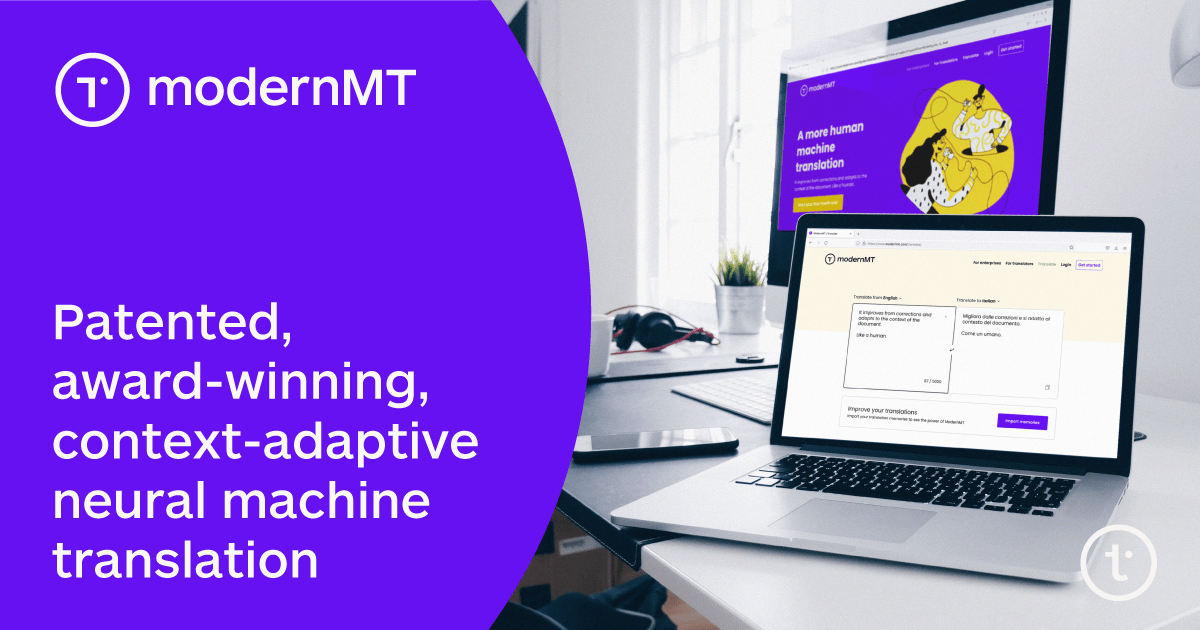
ModernMT learns while you work, which is a genuinely different model from every other engine here. Rather than requiring a retraining cycle, it adapts in real time from the corrections a translator makes, so the output improves across a project and comes to reflect that client's terminology and house style without anyone building a custom model. For an agency handling ongoing work for the same customer, that compounds.
It also reads document-level context rather than treating each sentence in isolation, which resolves the ambiguities — pronoun reference, terminology carried from an earlier paragraph — that sentence-level translation gets wrong in ways a reader notices. CAT tool integration means it slots into a professional workflow beside Trados rather than competing with it, and an API covers developer integration with custom glossaries.
ModernMT is based in Rome with EU processing and an open-source foundation, so the system can be inspected rather than only trusted. Pricing starts around €25 per month. This is a professional and developer tool rather than a consumer one: there is no free consumer tier and its value only appears when it is embedded in a workflow that generates corrections for it to learn from.
What ModernMT does well
- Adapts in real time from your corrections, with no retraining cycle
- Document-level context rather than sentence-by-sentence
- CAT tool integration and a developer API with custom glossaries
- Open-source foundation, so the system can be inspected
- Italian company with EU processing
Where ModernMT falls short
- Professional and developer tool; no consumer free tier
- Value only appears inside a workflow that produces corrections
- Smaller than DeepL on language coverage
- From about €25/month, aimed at agencies rather than individuals
Standout feature. Learning from corrections as they happen: ModernMT is the only engine here that gets better during a project rather than between projects.
Stuttgart, Germany
Founded 1978
Free / Premium available
Free
Best for: Language learners and educators wanting a reliable dictionary
PONS is a dictionary publisher rather than a technology company, and for reference work that lineage is the argument. PONS has been producing bilingual dictionaries since 1978 as part of PONS Langenscheidt, and the online product carries that editorial authority: entries are compiled and checked rather than derived from a corpus, which makes them more reliable on core meaning and register than anything generated automatically.
Coverage spans 36 languages with a European focus, including the pairs that matter for European business and study rather than only the global majors. Audio pronunciations handle the part a written dictionary cannot, and the vocabulary trainer turns lookups into retention — which is the difference between a dictionary and a learning tool. Mobile apps provide offline access, useful when travelling or in a classroom without reliable connectivity.
PONS GmbH operates from Stuttgart with EU jurisdiction and GDPR compliance. The core product is free with Premium available. The limits: PONS is reference rather than translation, its text translation is weaker than DeepL, and it will not show you a phrase in living context the way Linguee does. It is the tool for the word you do not know, not for the sentence you cannot phrase.
What PONS does well
- Dictionary-publisher authority since 1978
- Entries compiled and checked rather than corpus-derived
- 36 languages with a genuine European focus
- Audio pronunciations and a vocabulary trainer
- German company, EU jurisdiction, free core product
Where PONS falls short
- Reference rather than translation; text translation is weaker
- Does not show phrases in living context like Linguee
- Premium needed for the full feature set
- Not open source
Standout feature. Compiled by lexicographers: PONS is the only reference here whose entries were written and checked by people rather than derived from whatever a corpus contained.
Paris, France
Founded 2016
Free tier / paid plans by translated word count
Free tier
Best for: Businesses that need their whole website in several languages, quickly
Weglot translates an entire website without touching the code, which is a different product from the translation engines elsewhere in this category. DeepL translates text you give it; Weglot detects everything on your site, translates it, serves it at language-specific URLs and keeps it in sync as the site changes.
The part that decides whether a multilingual site is worth building is SEO, and it is where do-it-yourself approaches quietly fail. Translated pages need their own indexable URLs and correct hreflang tags, or search engines treat them as duplicates and the translation earns nothing. Weglot handles that automatically, which is the difference between a site that ranks in five markets and a site that merely displays in five languages.
It works with any CMS or framework rather than requiring a particular one, combines machine translation with the ability to edit or order professional translation for the pages that matter, and reports more than 110,000 users from small Shopify shops to large enterprise sites.
Weglot SAS operates from Paris, founded in 2016, with EU processing under GDPR. Pricing is by translated word count with a free tier — and the word-count model is the thing to model carefully, because a large catalogue site can be considerably more expensive than the entry plan suggests.
What Weglot does well
- Translates a whole website with no code changes
- Language URLs and hreflang handled automatically for SEO
- Works with any CMS or framework
- Machine translation editable, with professional translation available
- French company, EU processing, free tier available
Where Weglot falls short
- Word-count pricing gets expensive on large catalogues
- Translation quality is machine-first unless you pay to edit
- Adds a dependency in front of your site
- Not a general-purpose translation tool
Standout feature. Correct hreflang and language URLs without touching the code — the part that decides whether translation earns anything.
Hamburg, Germany and Prague, Czech Republic
Founded 2010
Quote-based; no public price list
Free trial
Best for: Teams translating a product continuously, not a document once
Phrase is a translation management system rather than a translation engine, and that distinction decides whether it is the right tool at all.
DeepL translates a text you hand it; Phrase manages the process around thousands of strings that keep changing — translation memory so the same sentence is paid for once, glossaries that hold terminology across releases, and connectors into GitHub, Figma and the CMS so new strings arrive without anyone exporting a spreadsheet. It plugs into DeepL and the other engines rather than competing with them.
The company is European twice over: Phrase GmbH in Hamburg, registered as HRB 109537 at Amtsgericht Hamburg, and Phrase a.s. in Prague, company ID 247 07 139.
It is the merger of Memsource, founded in Prague in 2010, and PhraseApp of Hamburg, unified under the Phrase name in 2022.
The platform itself runs on Amazon Web Services, with Phrase Studio on Google Cloud, and the published security documentation names no EU-only region. So the company answers to German and Czech law while the data sits with two American hyperscalers. That is worth knowing before a legal team signs, and it is why this page carries no EU-residency claim. ISO 27001 certified and SOC 2 Type I, with Type II expected in 2026. Pricing is quote-based with no public list.
What Phrase does well
- Translation memory and glossaries pay off across releases, not per document
- Connectors into GitHub, Figma and common CMSes remove the export step
- Engine-agnostic: works with DeepL and others rather than replacing them
- Two EU legal entities, ISO 27001 certified
Where Phrase falls short
- Runs on AWS and Google Cloud with no documented EU-only region
- No public pricing — every plan goes through sales
- Overkill for anyone translating occasional documents rather than a product
Standout feature. European ownership on American infrastructure, stated rather than glossed over.
Budapest, Hungary
Starter from €2,750/year (1 PM licence + 5 linguist subscriptions); Essential, Professional and Enterprise tiers by quote
Free trial available
Best for: Translators who want to own their toolkit
memoQ is the CAT tool of choice for translators who would rather own a licence than rent a translation management platform.
Every segment translated is stored in a translation memory that proposes matches on the next similar sentence, term bases enforce agreed vocabulary, and LiveDocs lets a translator align existing bilingual documents into reusable reference material without retyping anything. Both a desktop client and a browser-based online editor are available, so work is not tied to one machine. Alongside Trados, memoQ is the other name freelance and in-house translators actually mention when picking a CAT tool.
memoQ Translation Technologies Ltd. operates from Budapest under Hungarian and EU jurisdiction, publishing a Starter licence at about €2,750 per year for one project manager plus five linguist subscriptions — cheaper and more transparent than most CAT competitors' entry pricing for a small team, though Essential, Professional and Enterprise tiers step up to quote-only pricing as a team grows.
A free trial is available before buying, which several of the business-management tools further down this list do not offer. The trade-off is scale: Trados' installed base and RWS ecosystem remain larger for agencies buying at volume.
What memoQ does well
- Translation memory, term bases and LiveDocs reference alignment built in
- Desktop and browser-based editors, so work is not tied to one machine
- Starter licence priced and published, unlike most CAT competitors here
- Free trial available before buying
- Hungarian company, EU jurisdiction
Where memoQ falls short
- Essential, Professional and Enterprise tiers are quote-only
- A CAT tool for translators, not a full business-management platform for agencies
- Not open source
- Interface has a learning curve like any professional CAT tool
Standout feature. A published Starter price: memoQ is one of the few professional CAT tools here that states the entry cost before a sales call.
Paris, France
Founded 1968
Translate Pro Plus from €17.99/user/month, Pro Premium from €34.99/user/month (both annual billing); Enterprise and Developer API by quote
14-day free trial
Best for: Enterprises wanting a second European machine translation engine
Systran is the oldest machine translation company in this directory, tracing back to 1968, and it is now the only pure MT engine here besides DeepL and ModernMT.
Systran Translate Pro covers document and PDF translation across more than 55 languages with a browser interface, while a separate Enterprise and Developer API lets a company embed the same engine into its own product rather than using a translation website. For a company that already evaluated DeepL and wants a second, differently trained European engine to compare or fall back on, Systran is a reasonable next name to test.
SYSTRAN S.A. operates from Paris under French and EU jurisdiction, and ChapsVision announced its acquisition of SYSTRAN on 11 January 2024, so the current company trades as SYSTRAN by ChapsVision.
Pricing is published for the consumer product: Pro Plus from €17.99 per user per month billed annually, Pro Premium from €34.99, both with a 14-day free trial, while Enterprise and Developer API pricing goes through sales. That is more transparent than ModernMT's agency-only positioning, though Systran's translation quality on the core European language pairs is generally judged behind DeepL's, and most companies still default to the DeepL name first.
What Systran does well
- Machine translation engine with more than five decades of history
- Published consumer pricing with a 14-day free trial
- Separate Enterprise and Developer API for embedding translation into a product
- 55+ languages with document and PDF translation
- French company, EU jurisdiction
Where Systran falls short
- Translation quality on core European pairs generally trails DeepL
- Ownership has changed hands more than once since the 2010s, most recently to ChapsVision in 2024
- Not open source
- Less brand recognition than DeepL for a casual user
Standout feature. The longest history in this category: Systran has been building machine translation since 1968, longer than any other name here.
Beaconsfield, United Kingdom
Founded 2001
Quote-based across every product (XTM Platform, XTM TMS, XTM XTRF, XTM Rigi, XTM Transifex); no published tiers
Demo on request
Best for: Enterprises managing localisation across many product teams
XTM International runs a translation management system built for companies coordinating localisation across many product teams and languages at once, not for a single translator working alone.
Content connects in through 80-plus integrations, translation memory and terminology carry across projects, and machine translation from multiple providers can pre-fill segments for human review. XTM has expanded by acquisition rather than staying a single product: it now also owns XTRF, a business-management system for language service providers, and Transifex, a continuous-localisation platform for software strings, so a customer can end up on any of several XTM-branded products depending on which team they talk to.
XTM International Limited has been incorporated in England and Wales since 16 May 2001, which means UK jurisdiction under an adequacy decision rather than EU establishment — the same position as Trados, already in this category.
Every XTM product prices by quote: the site states pricing "designed around your organisation, scale and localisation complexity," with no published tiers and no self-service trial, only a demo booking. That is a heavier sales process than memoQ's or Systran's published entry prices, which is why XTM tends to appear on enterprise shortlists rather than in a small team's first search.
What XTM International does well
- Translation management system built for many teams and languages at once
- 80+ integrations and multi-provider machine translation pre-fill
- Also owns XTRF (LSP business management) and Transifex (continuous localisation)
- Established since 2001
- UK company, adequacy decision
Where XTM International falls short
- Fully quote-based pricing; no published tiers or self-service trial
- UK jurisdiction, not EU establishment, the same limitation as Trados
- Several XTM-branded products can be confusing to compare
- Not aimed at a single freelance translator
Standout feature. One company, several platforms: XTM now also owns XTRF and Transifex, so the product a customer ends up on depends on which team sold it.
Belvaux, Luxembourg
Essential, Smart and Enterprise from about €150/power user/month billed annually (Enterprise tier published; Essential and Smart not priced on the page); Infinity by quote; Agentic AI add-on from €450/month
Free trial available
Best for: LSPs wanting CAT and business tools in one login
Wordbee combines a CAT editor with the business side of running translation projects, which is the same territory as Plunet and XTRF but delivered as one login rather than a CAT tool plus a separate management system bolted on.
Power users manage workflows and vendors, linguists translate inside the built-in CAT editor, and an "agentic AI" add-on lets a team plug in its own OpenAI, Claude, Mistral or Gemini key for QA and routing rather than being locked to one model provider. Fifteen-plus integrations cover platforms like GitHub, Sitecore and WordPress, so content can flow in without a manual export step.
Wordbee S.A.R.L is registered in Belvaux, Luxembourg, and governed by Luxembourg law, putting it under EU jurisdiction alongside Plunet and Phrase rather than the UK jurisdiction of Trados and XTM.
Pricing is published for the Enterprise tier at €150 per power user per month billed annually, covering 20 power users, 500 linguists and 5 TB of storage, with a free trial available; the Essential and Smart tiers below it and the Infinity tier above it are not priced on the page, so the entry cost for a small team is not fully transparent despite the Enterprise number being public.
The agentic AI add-on is a separate, considerably more expensive subscription on top, starting at €450 per month.
What Wordbee does well
- CAT editor and business/vendor management in one login
- Bring-your-own-LLM AI add-on rather than a single locked-in model
- 15+ integrations including GitHub, Sitecore and WordPress
- Free trial available
- Luxembourg company, EU jurisdiction
Where Wordbee falls short
- Only the Enterprise tier price is published; Essential and Smart are not
- Agentic AI add-on is a separate, expensive subscription
- Not open source
- Smaller ecosystem than Phrase or XTM International
Standout feature. One login for both translating and managing the project around it, priced from a published €150 per power user per month.
Berlin, Germany
AgencyStart (from 2 full user licences), AgencyPlus, AgencyAdvanced and Enterprise editions, all quote-based
Free demo version
Best for: Agencies needing quoting, invoicing and vendor management
Plunet BusinessManager is a business-management system for translation agencies and in-house language departments, not a CAT tool — it does not translate anything itself, but sits around whichever CAT tool a team already uses, handling quotes, orders, invoicing, vendor management and reporting.
That makes it the direct counterpart to XTRF, now owned by XTM, and to the management side of Wordbee's platform, but sold as a standalone product a company can pair with any translation memory tool rather than being tied to one.
For an agency whose CAT tool is fine but whose quoting and invoicing are still done by hand or in spreadsheets, Plunet is the specific gap it fills.
Plunet GmbH is headquartered in Berlin, with its registered legal seat in Würzburg under German commercial register HRB 8292, putting it under German and EU jurisdiction; a separate Plunet Inc. handles the US market.
Pricing across all four editions — AgencyStart, AgencyPlus, AgencyAdvanced and Enterprise — is quote-based with no published figures, though AgencyStart is scoped from two full user licences, which signals it is built for a small agency rather than only large ones. Plunet offers a free demo version rather than a self-service trial, so evaluating it takes a sales conversation before a team can see it running on its own data.
What Plunet does well
- Business management for agencies: quotes, orders, invoicing and vendor management
- Works alongside any CAT tool rather than requiring one
- AgencyStart edition scoped for teams from two licences
- Free demo version available
- German company, EU jurisdiction
Where Plunet falls short
- No published pricing on any edition; quote-based throughout
- Does not translate anything itself — a second purchase alongside a CAT tool
- Demo rather than a self-service trial
- Not open source
Standout feature. The business layer without the CAT tool: Plunet is built to sit alongside whichever translation memory tool an agency already has.
Ramsen, Switzerland
Founded 1984
Quote-based; no published pricing, contact STAR Group for Transit and TermStar
Demo on request
Best for: Long-established LSPs wanting corporate language management
STAR Transit is a CAT tool and translation-memory suite that has been running for four decades, longer than every other CAT tool in this category except Trados.
TermStar handles terminology alongside it, and Transit connects to machine translation from Amazon, DeepL, Google, Microsoft, OpenAI and others so a translator can route a segment through whichever engine fits rather than being locked to one. STAR Group positions the whole suite around corporate language management and content-delivery workflows for organisations translating continuously rather than project by project, which is a heavier proposition than a single freelance translator typically needs.
STAR AG has operated from Ramsen, Switzerland since the STAR Group's founding in 1984, which places it outside the EU and EEA under a Swiss adequacy decision rather than EU establishment — the same jurisdictional position as Trados and XTM International in this category, though a different country.
No pricing or trial is published anywhere on the site; every route runs through a phone call or a contact form requesting an online demonstration, which is less transparent than memoQ's published Starter price or Systran's public consumer tiers.
For an organisation already inside STAR Group's ecosystem for other language services, Transit is a known quantity; for a newcomer comparing options, the lack of any public price is a real cost of finding out.
What STAR Transit does well
- Translation memory and terminology (TermStar) with four decades of development
- Connects to machine translation from Amazon, DeepL, Google, Microsoft and OpenAI
- Corporate language management for organisations translating continuously
- Long-established Swiss vendor with a global network
- Swiss company, adequacy decision
Where STAR Transit falls short
- No published pricing or trial anywhere on the site
- Outside the EU and EEA, adequacy decision rather than EU establishment
- Aimed at continuous, organisation-wide translation rather than a single project
- Not open source
Standout feature. Four decades and counting: STAR Transit is the only CAT tool here besides Trados with a development history from the 1980s.
Karlsbad, Germany
Quote-based; no published pricing, demo and advisory conversation on request
Demo on request
Best for: In-house teams centralising memory across departments
Across Language Server is a translation management system built to sit at the centre of a company's language work, holding one shared translation memory and terminology base that every department and external vendor draws from rather than each team keeping its own.
Workflow automation routes content to the right translator or reviewer, and machine translation integration lets an engine pre-fill segments before a human corrects them — the same shape as XTM and Wordbee, aimed at the same buyer: a company or agency managing translation as an ongoing process rather than a one-off document.
Across Systems GmbH is registered in Karlsbad, Germany, under commercial register HRB 362882 at the Mannheim court, giving it German and EU jurisdiction alongside Plunet.
The company states more than 25 years in the market but does not publish a specific founding year, and — like STAR Transit and Plunet — publishes no pricing or trial anywhere on the site: every route runs through a contact form for "a no-obligations advisory conversation or an online demonstration." That puts the buying process on the same footing as STAR Transit's rather than memoQ's published entry price, and a prospective customer should expect a sales conversation before seeing a number.
What Across Language Server does well
- One shared translation memory and terminology base across departments and vendors
- Workflow automation routes content to translators and reviewers automatically
- Machine translation integration for pre-filling segments
- Over 25 years in the translation management market
- German company, EU jurisdiction
Where Across Language Server falls short
- No published pricing or trial; every route goes through sales
- No founding year stated, only "over 25 years"
- Interface and workflow are aimed at ongoing operations, not casual use
- Not open source
Standout feature. Everything answers to one memory: Across is built so every department and vendor draws from the same translation memory rather than keeping their own.