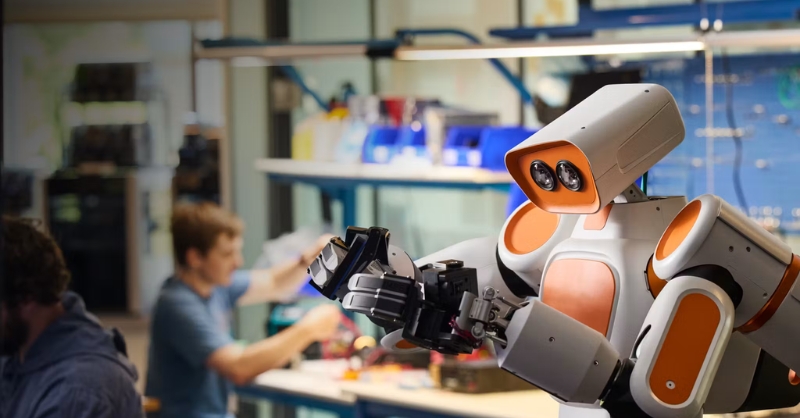
A $300M Seed Round and a $1.1B Valuation — In Under Six Months
Walden Robotics, a Cambridge, Massachusetts-based startup that emerged from Toyota's research laboratories, has burst out of stealth mode with a staggering $300 million seed funding round, earning it a valuation of $1.1 billion — all within just six months of its founding. This AI robotics startup funding milestone is one of the largest seed rounds ever recorded in the technology sector, and it places Walden Robotics firmly in the upper echelons of the global robotics investment landscape before the company has even shipped a commercial product.
For developers, IT decision makers, and policy professionals closely watching the intersection of artificial intelligence, physical automation, and digital infrastructure, this funding announcement carries implications that extend well beyond a single venture capital headline. It reflects a seismic shift in how investors, enterprise buyers, and sovereign technology strategists are thinking about intelligent machines, the data they generate, and the infrastructure required to support them.
According to reporting by Tech Funding News, the round positions Walden Robotics as one of the fastest companies in history to achieve unicorn status — a feat that underscores the explosive investor confidence in applied AI for physical environments.
From Toyota's Research Lab to Independent Unicorn — How Walden Robotics Was Born

Walden Robotics traces its origins to Toyota Research Institute (TRI), one of the most well-resourced and ambitious industrial AI labs in the world. Toyota has long been a pioneer not just in automotive manufacturing but in applied robotics research, having invested hundreds of millions of dollars into AI systems designed to bridge the gap between digital intelligence and physical task execution. Walden's founding team reportedly includes researchers and engineers who were central to TRI's most advanced robotics programmes.
Spinning out of a corporate research lab is not a novel concept in deep tech — companies like DeepMind (Google), Waymo (Alphabet), and numerous biotech spinouts have followed a similar path. What makes Walden Robotics exceptional is the sheer velocity of its fundraising. Achieving unicorn status as part of a seed round — typically the earliest and smallest form of institutional funding — signals that investors view this team's accumulated intellectual property, expertise, and research pipeline as extraordinarily valuable, even before commercial deployment.
"When you spin a team like this out of one of the most advanced industrial AI labs on the planet, you're not starting from zero — you're starting from years of proprietary research and hard-won operational knowledge," said a robotics venture capital analyst familiar with the deal. "That's why the market is pricing this company at $1.1 billion before they've sold a single unit."
According to data published by Statista, the global robotics market is projected to grow substantially over the coming decade, with service and industrial robotics driven overwhelmingly by AI integration. The timing of Walden's emergence aligns precisely with this inflection point.
How Does $300M in AI Robotics Startup Funding Compare to Industry Benchmarks?
To understand why this funding round commands attention beyond the robotics community, it helps to benchmark it against the broader venture landscape. According to research tracked by TechCrunch's robotics coverage, typical seed rounds in deep tech range from $2 million to $20 million. A $300 million seed round is categorically different — it resembles the scale of a Series B or Series C in conventional software startups, applied at the very earliest stage of a company's independent life.
For context, the robotics and AI automation sector has seen a dramatic acceleration in investment since the emergence of large language models and multimodal AI systems. Investors have begun to recognise that physical AI — systems capable of perceiving, reasoning about, and acting in the real world — represents the next major platform shift after cloud computing and mobile. McKinsey analysis on the future of automation has consistently pointed to robotics as a key lever for productivity in logistics, healthcare, and manufacturing — sectors already grappling with labour shortages and supply chain fragility.
| Company | Funding Stage | Amount Raised | Focus Area |
|---|---|---|---|
| Walden Robotics | Seed | $300M | AI robotics (Toyota spinout) |
| Figure AI | Series B | $675M | Humanoid robots |
| 1X Technologies | Series B | $100M | Humanoid / industrial robots |
| Physical Intelligence | Series A | $400M | General-purpose robot AI |
What AI Robotics Investment Means for Cloud Infrastructure and Data Sovereignty
For IT decision makers and enterprise architects, the rise of well-funded AI robotics companies like Walden raises a set of infrastructure questions that go directly to the heart of topics like data sovereignty, cloud dependency, and regulatory compliance. Intelligent robots are, at their core, data machines. They generate vast streams of sensor data, video, telemetry, and environmental mapping information — all of which must be processed, stored, and in many cases, transmitted to remote inference engines or cloud platforms.
This creates a tension that privacy professionals and policy makers in Europe are already grappling with. When a robot deployed in a warehouse or hospital captures environmental data and transmits it to a cloud provider based in a non-EU jurisdiction, that data flow immediately comes into contact with GDPR obligations, data localisation considerations, and the broader framework of digital sovereignty that the European Union has been constructing through legislation including the Data Act and the AI Act.
The European Commission's Digital Strategy has explicitly identified robotics and AI as sectors where European technological autonomy must be actively cultivated, in part to avoid the kind of infrastructure dependency on non-European platforms that has characterised the cloud computing era. The emergence of highly capitalised American AI robotics startups — even those with strong academic pedigrees — is likely to intensify regulatory scrutiny of data flows between robotic systems and their supporting cloud infrastructure.
"The question for enterprise buyers is not just whether the robot works — it's where the data goes, who can access it, and whether that arrangement complies with the regulatory framework in which you operate."
— Enterprise IT analyst perspective on AI robotics procurementFor small business owners and entrepreneurs considering automation solutions, this regulatory complexity is not abstract. A logistics SME deploying AI-driven picking robots in an EU facility must understand whether their vendor's data infrastructure is compliant by design, or whether compliance is an afterthought that requires additional contractual and technical architecture work.
Open Source Robotics and the Case for Sovereign AI Infrastructure

The commercial robotics market is not monolithic. Alongside heavily funded proprietary platforms like the one Walden Robotics is building, a robust open source robotics ecosystem — centred around frameworks like ROS 2 (Robot Operating System) — provides organisations with an alternative path that prioritises transparency, modularity, and control over data flows. For organisations with strong digital sovereignty requirements, open source robotics frameworks offer the ability to audit inference pipelines, control where data is processed, and avoid vendor lock-in.
This is particularly relevant for European enterprises and public sector organisations that are increasingly guided by procurement frameworks that favour software with auditable codebases and data residency guarantees. The European Open Source Strategy and similar national-level digital autonomy policies are creating a policy environment in which open source AI and robotics solutions may hold a structural advantage in public tenders and regulated sectors.
The bar chart below illustrates investor focus across different AI robotics categories, reflecting where capital is being concentrated as the sector matures:
Originally reported by Tech Funding News. Summarised and curated by European Purpose.