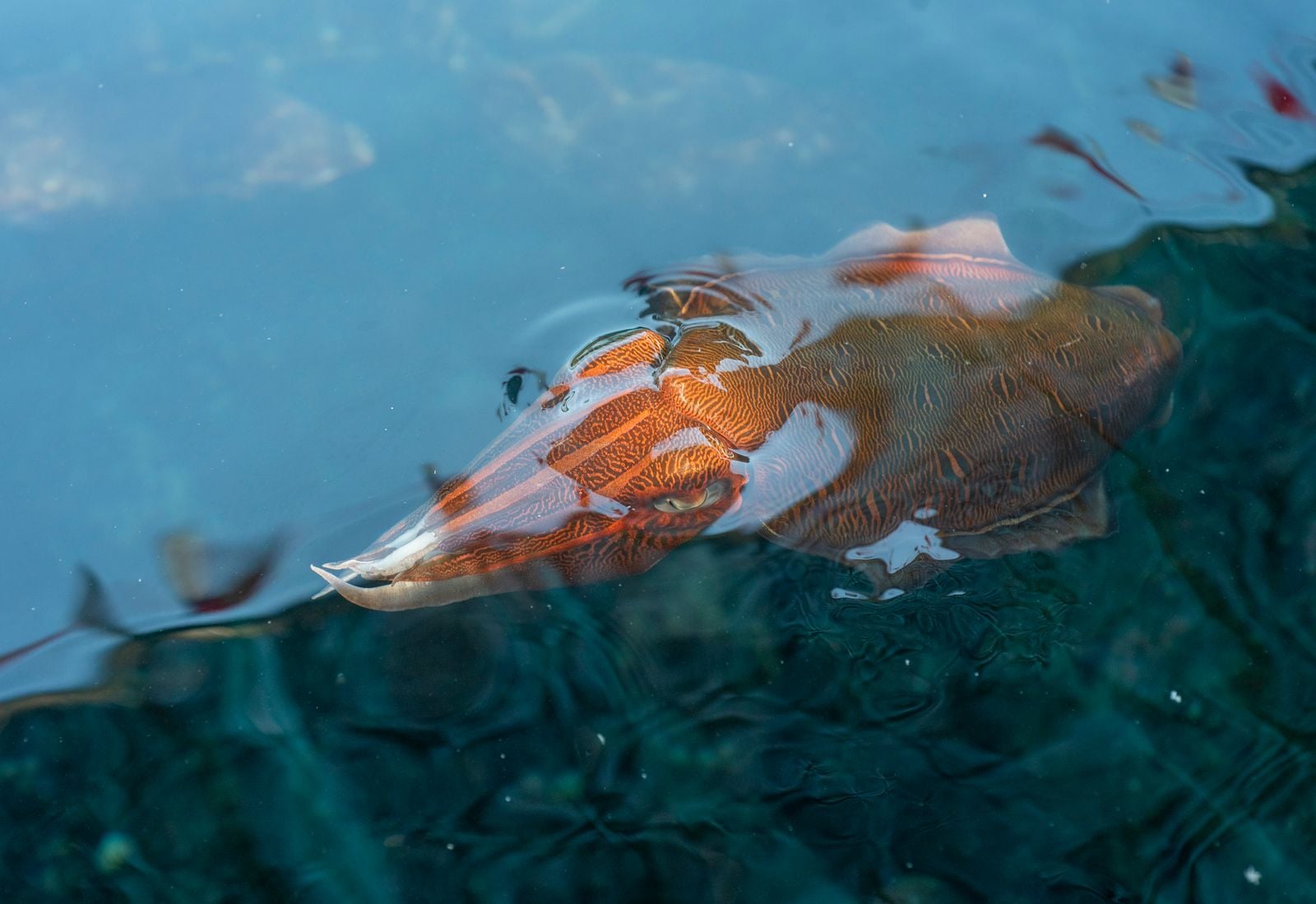
The Paradox at the Heart of Cuttlefish Camouflage
Cuttlefish camouflage colour blindness sits at the centre of one of biology's most compelling unsolved puzzles. The common cuttlefish — Sepia officinalis — can blend into its surroundings with a precision that rivals anything a human designer might engineer, producing skin patterns that closely match the reflectance spectra of the background beneath it. Yet rigorous behavioural experiments consistently show that the animal cannot distinguish colour in any conventional sense. It appears to operate with just one type of retinal visual pigment, leaving it technically monochromatic — colour-blind in the same way that a black-and-white camera is colour-blind. How, then, does it so convincingly replicate coloured environments?
The answer, researchers are increasingly convinced, lies not in some hidden colour receptor or secret perceptual trick, but in the sophisticated integration of multiple non-colour visual channels — brightness, contrast, polarisation, depth, texture, and the passive optics of the skin itself. Understanding this system does more than satisfy biological curiosity. It offers a striking model of how intelligence and perception can produce accurate, context-sensitive output through means entirely different from what an observer might assume. For technologists, system architects, and anyone thinking about how complex outputs emerge from constrained inputs, the cuttlefish is a case study worth understanding.
What Controlled Experiments Actually Show About Cuttlefish Colour Vision
The foundational evidence comes from a carefully designed experiment involving coloured checkerboard patterns. Researchers working with Sepia officinalis created boards whose coloured squares were brightness-matched specifically for the cuttlefish visual system — meaning the squares differed in wavelength (colour) but not in perceived luminance. When placed on these boards, the cuttlefish produced non-disruptive, uniform-looking skin patterns, as though the squares were indistinguishable. The experiment, published in Vision Research, remains the strongest behavioural evidence that common cuttlefish lack conventional colour discrimination.
Yet the same animal, when placed on natural substrates in the wild, produces skin patterns whose reflectance spectra closely match those of the surrounding environment. To an external observer — or to a predator — the cuttlefish looks chromatically accurate. Two facts appear to contradict each other: the animal cannot see colour, yet it produces chromatic matches. Resolving that contradiction requires looking beyond the eye and into the broader optical and neural system the cuttlefish deploys.

Why the W-Shaped Pupil Is More Than an Optical Curiosity
The cuttlefish pupil is one of the most distinctive in the animal kingdom. In darkness, it is broadly circular; in bright light, it contracts into a wavy, horizontal W-shape. A 2013 study in Vision Research established the most well-supported function of that shape: light management. The constricted pupil reduces illumination from the bright water above more strongly than it reduces horizontal light, limiting glare and preserving useful vision towards the seafloor and forward angles.
A second, more speculative function involves chromatic aberration. Different wavelengths of light are focused at slightly different distances by a lens — a phenomenon familiar to optical engineers. Cuttlefish focus by moving a fixed-shape lens relative to the retina rather than changing lens shape as humans do. In principle, as the lens moves, the sharpness of an image at different focal positions could carry some wavelength information, even with a single visual pigment. The W-shaped pupil may preserve certain optical conditions that make this aberration-based signal more detectable.
This is a compelling hypothesis — not a confirmed mechanism. It would represent a fundamentally different computational strategy from the trichromatic comparison system that human vision uses. Rather than comparing outputs from three receptor types simultaneously, the cuttlefish might extract spectral information sequentially, through focus-shifting over time. Researchers have not yet demonstrated that this happens during real camouflage behaviour, but the optical model is mathematically plausible.
"The cuttlefish visual system forces us to question our assumptions about what colour perception requires. It may achieve wavelength sensitivity through temporal sampling rather than simultaneous receptor comparison — a fundamentally different architecture with similar functional outputs."
— Cephalopod vision researcher, summarising the chromatic aberration hypothesis in the context of current debatePolarised Light as a Hidden Sensory Channel
While cuttlefish lack colour vision in the human sense, they possess unusually refined sensitivity to polarised light — the orientation of a light wave's electric field, which is entirely distinct from wavelength. Underwater, polarisation adds contrast to reflections, transparent tissues, and objects that are otherwise difficult to detect. It is a visual channel largely invisible to humans without instruments.
Cuttlefish skin structures are also capable of producing polarised reflections. Researchers have investigated whether these reflections serve as communication signals between cuttlefish — potentially visible to conspecifics while remaining invisible to colour-sensitive predators with poor polarisation discrimination. The hypothesis is plausible and supported by structural evidence, but has not yet been demonstrated as a functioning communication system in natural behaviour. According to reporting by Wired on cephalopod biology, the complexity of cuttlefish signalling continues to surprise researchers who initially assumed the animals' perceptual world was relatively simple.
Polarisation, depth perception, edge contrast, and luminance together form the actual sensory substrate through which the cuttlefish perceives its environment. These are not impoverished substitutes for colour — they are distinct channels that collectively deliver rich environmental information, encoded and decoded by one of the most densely innervated skin systems in the animal kingdom.
How Millions of Pigment Organs Create a Living Display
The visible output of all this neural processing is produced by chromatophores — elastic pigment organs directly controlled by motor neurons. Each chromatophore contains a central sac of pigment surrounded by radial muscle fibres, typically numbering between 15 and 25. When the muscles contract under neural command, the sac expands into a broad coloured disc. When neural input stops, elastic recoil draws it back. The cuttlefish brain coordinates enormous numbers of these organs simultaneously, layering yellow, orange, red, and brown-black pigments with reflective iridophores and light-scattering leucophores beneath them.
A July 2026 study published in eLife applied a computer-vision pipeline called CHROMAS to both the hummingbird bobtail squid Euprymna berryi and the common cuttlefish Sepia officinalis. CHROMAS, introduced in a related 2025 methods paper, divided chromatophores into radial slices and analysed their changing shapes over time. The researchers inferred an average of approximately four independent control components within each chromatophore — not a single uniform disc, but a set of petal-like regions that could be partially controlled independently. This challenges the intuitive "biological pixel" metaphor. Each chromatophore is better understood as a small, multi-component actuator rather than a simple on/off switch.
The study also identified putative motor units spanning multiple chromatophores, with most units involving fewer than 14 chromatophores arranged in compact, elongated, or fragmented geometric patterns. Expansion of chromatophores was generally faster and more repeatable than relaxation — consistent with an actively driven system that returns more passively via elastic recoil. These findings are computationally inferred rather than directly observed electrophysiologically, and should be interpreted accordingly, but they significantly complicate the picture of how cuttlefish skin is controlled.
| Skin Cell Type | Function | Control Mechanism |
|---|---|---|
| Chromatophores | Pigment display; contrast and pattern | Direct motor neuron innervation |
| Iridophores | Structural and iridescent colour reflections | Neural and potentially hormonal signals |
| Leucophores | Broadband light scattering; passive colour matching | Largely passive; reflects ambient illumination |
| Dermal photoreceptors | Possible local light sensing in skin | Under active investigation; not yet confirmed |
The Role of Passive Skin Optics in Achieving Colour Matches
Leucophores — the broadband light-scattering cells beneath the chromatophore layer — offer a partial resolution to the colour-blindness paradox. Because leucophores scatter incoming light across a wide range of wavelengths, they effectively reflect whatever ambient light is present. Under reddish illumination, they return more red; under bluish light, more blue. Chromatophores above them regulate contrast, darkness, and the spatial distribution of pigment, while iridophores add further wavelength-dependent reflective effects.
The result is a skin system that passively picks up spectral characteristics from the environment even when the brain is not explicitly encoding colour. The cuttlefish does not need to "see red" to produce a reddish skin patch in a reddish environment — the leucophores do some of that work automatically. This does not mean camouflage is a purely passive process: brightness, edge detection, spatial scale, and texture remain under active neural control. But it does explain how a colour-blind nervous system can produce outputs that a colour-sensitive observer would describe as chromatically accurate.
Research published in journals including Nature has placed this work within a broader framework of cephalopods as integrated sensor-display systems, where eyes, brain, peripheral tissues, and skin interact continuously rather than forming a simple input-output pipeline. The skin is not just a screen — it is part of the sensing apparatus.

Originally reported by Silicon Canals. Summarised and curated by European Purpose.