Why AI Infrastructure Is Breaking Clean Energy's Promises
The explosion in AI computing has exposed a structural weakness at the heart of the clean energy transition. Data centers powering large language models, cloud inference workloads, and enterprise AI platforms require uninterrupted electricity — twenty-four hours a day, seven days a week, regardless of weather or time of day. Solar panels go dark at night. Wind turbines stall in calm air. And the gap between clean energy's promise and the hard reality of always-on power demand is widening fast. For developers, IT decision-makers, and technology operators who are building and scaling digital infrastructure, this is not an abstract policy problem — it is an operational constraint with direct cost implications. A Los Angeles-based startup called Critical Energy believes it has a credible answer, and it just raised $22 million in seed funding to prove it. This is where geothermal energy for AI infrastructure enters the conversation in a serious way.
According to the U.S. Energy Information Administration, fossil fuels still accounted for 82% of U.S. energy consumption in 2023. Solar and wind, despite representing over 90% of new global power capacity additions, remain intermittent by nature. The result is a paradox: the world is investing record sums in renewable energy, yet the backbone of the grid — particularly the baseload power that keeps hyperscale data centers and enterprise cloud infrastructure online — remains largely dependent on natural gas and coal. For digital sovereignty advocates and policy professionals pushing for sovereign, resilient, and low-emission technology infrastructure in Europe and beyond, this tension is increasingly urgent.

From Rocket Engines to Geothermal Turbines: The SpaceX Connection
Critical Energy was founded in 2024 by Spencer Jackson, who spent seven years at SpaceX contributing to Falcon Heavy structural systems, Starship's thermal protection systems, and components for the Raptor engine. That background is not incidental — it is the intellectual foundation for the company's entire approach. At SpaceX, Jackson worked within an engineering culture that treated hardware as a product to be iterated, manufactured at scale, and continuously improved, rather than as a bespoke construction project assembled from scratch each time. He is bringing that same philosophy to geothermal power.
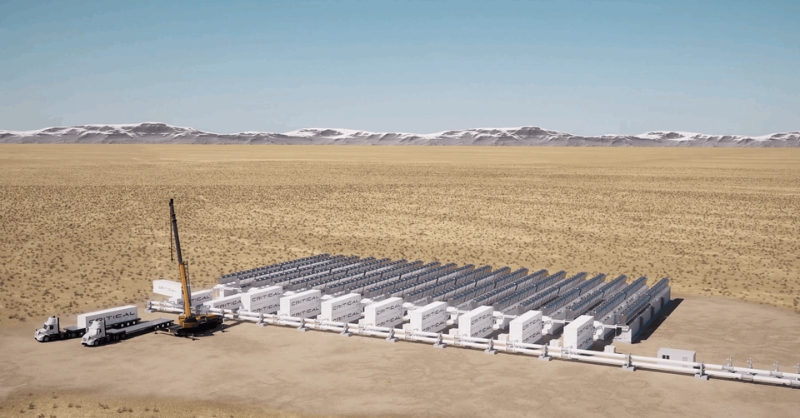
The company designs modular geothermal turbines — container-sized units built in-house that convert subsurface heat into electricity using a closed-loop fluid system and custom-designed machinery. Critically, the bulk of each system is assembled off-site in a factory environment, then shipped to deployment locations. Critical Energy claims this approach can compress deployment timelines from what is typically measured in years down to a matter of weeks. The company has already built a pilot facility in Los Angeles and is advancing toward larger commercial projects.
"Everyone talks about solving climate change, but the reality is we need massive amounts of always-on energy to do it. Today, the only energy source we've been able to scale quickly enough to meet that demand is natural gas. We're building a zero-emissions alternative that can match that reliability, and be deployed anywhere."
— Spencer Jackson, Founder and CEO, Critical EnergyThe analogy the company reaches for is Henry Ford's assembly line — a manufacturing breakthrough that made automobiles affordable and ubiquitous by systematizing production. Applied to energy infrastructure, this thinking challenges the prevailing model in which each power plant is effectively a unique engineering project, subject to site-specific permitting delays, bespoke supply chains, and extended construction timelines. For IT decision-makers evaluating long-term energy contracts for data center operations, the prospect of a standardized, rapidly deployable clean power unit carries obvious appeal.
Who Is Backing the $22M Seed Round?
The seed round was led by Susa Ventures and Upfront Ventures, two well-established venture capital firms with track records in technology infrastructure and deep tech. Susa Ventures has previously backed companies including Robinhood and Flexport. Additional investors in the round include MaC Venture Capital, Susquehanna Sustainable Investments, Humba Ventures, Scribble Ventures, and Underground Ventures. Silicon Valley Bank contributed venture debt to the round.
Seth Berman, General Partner at Susa Ventures, framed the investment explicitly around the reliability gap in clean energy infrastructure — a framing that will resonate with anyone who has had to negotiate power purchase agreements for cloud infrastructure or data center deployments.
"Clean energy doesn't just need to be abundant, it needs to be dependable. What stood out to us about Critical Energy is its focus on solving one of the most difficult challenges in the energy transition: delivering always-on, zero-emissions power at scale."
— Seth Berman, General Partner, Susa VenturesThe funding will be deployed toward expanding engineering and manufacturing capabilities, accelerating turbine development, and supporting initial commercial deployments in both the U.S. and internationally. The company's stated long-term ambition is to deliver more than 300 gigawatts of new installed power generation capacity per year by 2045 — a target that places it in competition not just with other geothermal startups, but with natural gas peaker plants and baseload nuclear facilities.
How Does Critical Energy Stack Up Against the Geothermal Field?
The geothermal energy sector has seen a significant influx of venture capital in recent years, driven in part by the growing recognition that intermittent renewables alone cannot satisfy the continuous power demands of AI and cloud infrastructure. Critical Energy's approach, however, is meaningfully differentiated from its two most prominent competitors, according to reporting by TechCrunch and industry analysts tracking the sector.
Fervo Energy, one of the best-funded players in the space, focuses on enhanced geothermal systems (EGS) — using horizontal drilling techniques and fiber-optic sensing to access geothermal resources in geologies where conventional systems would not function. Fervo raised $462 million in a Series E round in December 2025 and has been reported to be preparing for an IPO of up to $1.33 billion. Quaise Energy, an MIT spinout that has raised over $120 million, is developing millimeter-wave drilling technology to reach much deeper and hotter underground formations than conventional rigs can access.
Both Fervo and Quaise are fundamentally underground technology companies — their competitive differentiation lies in how they access heat. Critical Energy, by contrast, is focused on the surface: the turbines and mechanical systems that convert heat into electricity, regardless of how the well was drilled or by whom. This positions the company potentially as a supplier to the broader geothermal industry rather than a direct competitor to EGS drillers — a strategic distinction that could prove significant if the market expands as projected. As the International Energy Agency has noted in its energy transition roadmaps, scaling clean baseload power will require advances across the full value chain, not just in extraction technology.
| Company | Focus Area | Total Funding | Key Differentiator |
|---|---|---|---|
| Critical Energy | Modular surface turbines | $22M (seed) | Factory-built, rapid deployment |
| Fervo Energy | Enhanced geothermal systems | $462M+ (Series E) | Horizontal drilling + fiber sensing |
| Quaise Energy | Deep drilling technology | $120M+ | Millimeter-wave drilling to greater depths |

The Scale of the Clean Power Challenge for Digital Infrastructure
These numbers tell a story that energy policy professionals and infrastructure planners know well. The clean energy transition is producing enormous volumes of new intermittent capacity while the reliable, always-on baseload layer of the grid remains stubbornly carbon-intensive. Research published by the International Renewable Energy Agency (IRENA) has consistently highlighted the need for dispatchable clean power — energy sources that can be called upon on demand — as a critical missing piece in decarbonization strategies. Geothermal energy, by its nature, produces consistent output regardless of surface conditions, making it one of the few renewable sources that can genuinely serve a baseload function.
The deployment speed question is equally significant for digital infrastructure operators. Traditional geothermal plant construction can take five to ten years from exploration to commissioning, a timeline incompatible with the pace at which hyperscalers and enterprise cloud providers are expanding capacity. If Critical Energy can genuinely compress this to weeks through factory prefabrication — a claim that will face rigorous scrutiny as the company moves from pilot to commercial scale — it addresses one of the sector's most persistent bottlenecks.
Why Always-On Clean Power Matters for Digital Sovereignty and Cloud Infrastructure
For the audience that Europeanpurpose.com serves — developers building privacy-first applications, IT decision-makers managing cloud infrastructure, policy professionals working on digital sovereignty frameworks, and entrepreneurs building alternatives to hyperscale dependency — the energy question is not peripheral. It is foundational. The physical infrastructure layer that underpins cloud computing, data storage, and AI services runs on electricity. The carbon intensity, reliability, and geographic availability of that electricity shapes everything from data center siting decisions to the credibility of sustainability commitments in technology procurement.
Europe, in particular, has been grappling with this intersection through its digital sovereignty agenda. The EU's data sovereignty frameworks and cloud infrastructure initiatives, including efforts documented by Reuters covering European energy and tech policy, increasingly require not just data residency but energy transparency — knowing where power comes from and how reliable it is. A modular, deployable geothermal unit that can be placed near a data facility, rather than requiring connection to a distant renewable farm via long-haul transmission, offers a different model of infrastructure resilience.
The competitive dynamics here also intersect with the broader question of technological alternatives to U.S. hyperscale dominance. European cloud and AI operators building sovereign infrastructure need power solutions that are themselves sovereign — not dependent on fuel imports, not subject to commodity price volatility, and not conting
Originally reported by Tech Funding News. Summarised and curated by European Purpose.