Crimea's Infrastructure Collapse: A Modern Warfare Case Study
The Crimea infrastructure collapse unfolding in the Russian-occupied Ukrainian peninsula offers a stark, real-world demonstration of what happens when military conflict systematically targets the interconnected systems that modern societies depend on. ATMs are going offline. Petrol stations have run dry — and even black market fuel supplies have dried up. Power grids are failing. Public transport has ground to a halt. And a digital information blackout, enforced through Russian repression, is making it increasingly difficult to assess the full scale of what is happening on the ground.
For IT professionals, policy makers, and digital sovereignty advocates, the situation in Crimea functions as an extreme stress test of infrastructure resilience — one that exposes how quickly cascading failures across energy, financial, logistics, and communications systems can transform a functioning territory into a place where basic services are rationed and populations revert to cash, bicycles, and barter. As EUobserver reports, the peninsula is now operating under conditions resembling a lockdown, with shops and restaurants forced to close by nine in the evening, street lighting switched off, and all public events cancelled indefinitely.
The broader geopolitical backdrop matters. When Russian President Vladimir Putin annexed Crimea from Ukraine in 2014, in violation of international law, his domestic approval ratings surged to nearly 90 percent. Czech journalist and Russia specialist Ondřej Soukup described Crimea as "a central symbol of Putin's effort to right the 'wrongs' that allegedly occurred after the collapse of the Soviet Union." That symbolic weight makes the current deterioration particularly damaging for Kremlin messaging — and particularly revealing for analysts studying modern conflict and infrastructure vulnerability.
When ATMs Go Dark and Fuel Vanishes: What Infrastructure Failure Actually Looks Like
The sequence of failures in Crimea closely mirrors what cybersecurity professionals and infrastructure engineers describe as a "cascading failure" model — where the failure of one critical system triggers breakdowns in dependent systems in a compounding chain reaction. It began with fuel. Social networks were initially flooded with images of long queues at petrol stations. Then reports emerged that fuel had become unavailable even through black market channels — a notable signal, since informal supply chains are typically the last resort that persists when official systems collapse.
Fuel shortages then fed directly into public transport disruptions. Buses and trolleybuses — already hampered by power outages — were further restricted by Crimean authorities citing fuel constraints. The result: residents of cities like Sevastopol are increasingly relying on bicycles or travelling on foot. For anyone who has worked in business continuity planning, this is a textbook example of why redundancy and supply chain diversity are not optional extras — they are foundational requirements.
The payment system breakdown adds another layer of complexity. According to independent Russian investigative outlet iStories, which gathered detailed testimonies from residents, card payments are now unavailable in most shops across the peninsula. Only select supermarkets — specifically the Yabloko chain — were cited as exceptions. Meanwhile, an increasing number of ATMs have gone offline entirely. For a population suddenly forced back to cash-only transactions in a cash-scarce environment, this creates a financial access crisis that compounds every other shortage.
"The refrigerated display cases have been taped off with warning tape. From the smell, it seems that everything inside has already spoiled," one woman from Sevastopol told iStories — describing conditions in shops operating on generators that are insufficient to maintain cold chains. With daytime temperatures reaching approximately 29 degrees Celsius, the failure of refrigeration systems is not merely an inconvenience; it represents a direct food safety threat.
"Crimea has become a central symbol of Putin's effort to right the 'wrongs' that allegedly occurred after the collapse of the Soviet Union — which is precisely why these reports of infrastructure failure are so damaging for the Kremlin's narrative."
— Ondřej Soukup, Czech journalist specialising in Russia, via Denník NInformation Blackouts in Conflict Zones: Why Digital Sovereignty Matters When Reporting Is Suppressed
For professionals in the digital privacy and open-source intelligence space, the information environment around Crimea is as significant as the physical infrastructure story. Russian repression makes independent verification of conditions on the ground extremely difficult. The picture that emerges comes from a patchwork of anonymous testimonies, posts on encrypted social networks, pro-Ukrainian Telegram channels such as Krymskyi Vietor, and independent Russian journalism projects like iStories and Krym.Realii — outlets that operate under significant legal and personal risk.
This information environment illustrates, in high-stakes terms, the value of open, decentralised communication infrastructure. When a centralised authority controls information flows, the population inside the affected zone loses access to accurate situational awareness, while outside observers lose the ability to monitor humanitarian conditions. Telegram channels, despite their imperfections as a verified news source, have functioned as critical nodes for information transmission in exactly the kind of scenario that makes digital sovereignty advocates argue for distributed, censorship-resistant communications platforms.
The Crimean authorities' decision to restrict motorbike travel at night — reportedly to avoid interfering with air defence systems — was itself first reported through local Telegram channels, not official statements. This detail illustrates a recurring dynamic in modern conflict zones: unofficial, peer-to-peer digital communications often carry more accurate real-time information than official channels. For policy professionals thinking about information resilience frameworks, Crimea offers a current and concrete example to study.
How Cascading Infrastructure Failures Unfold: Lessons for Business Continuity Professionals
The pattern playing out in Crimea is documented extensively in infrastructure resilience literature. The European Union Agency for Cybersecurity (ENISA) has published multiple frameworks examining how attacks on critical infrastructure — whether physical or digital — produce ripple effects across interdependent systems. Energy systems are foundational: when power fails, refrigeration fails, payment terminals fail, communications infrastructure degrades, and water pumping stations stop operating. Each failure creates new pressure points in adjacent systems.
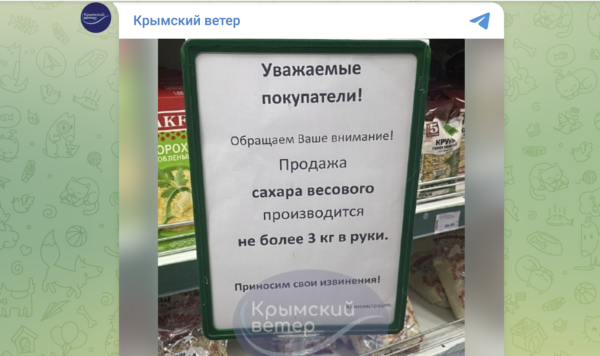
In Crimea, this theoretical model is playing out in real time. Power outages are causing water shortages — a direct consequence of electric pumping infrastructure. The resulting conditions are described by Soukup as "an enormous tragedy" for local residents. Authorities have responded with rationing measures: the purchase of sugar was capped at three kilograms per customer in Simferopol, according to a sign photographed and shared via the Krymskyi Vietor Telegram channel. Panic buying — a predictable behavioural response to supply uncertainty — has accelerated shortages further.
"Crimeans rushed into the shops and bought everything they could," the Sevastopol woman told iStories. "When we came back the next day, the shelves were already empty. People apparently panicked and bought everything up." This is a textbook demand shock triggered by uncertainty — the same dynamic that IT incident managers attempt to prevent by maintaining clear, credible communication during system outages. The information vacuum created by repression and blackouts directly contributes to panic behaviour that worsens material shortages.
| Infrastructure System | Reported Status in Crimea | Downstream Impact |
|---|---|---|
| Power Grid | Frequent, extensive outages | Water shortages, food spoilage, ATM failures |
| Fuel Supply | Critically depleted; black market also dry | Public transport halted, generator dependency |
| Payment Networks | Card terminals down in most shops; ATMs offline | Financial access crisis; cash-only economy |
| Food Cold Chain | Collapsed; refrigerated goods spoiling | Limited to non-perishable products only |
| Public Transport | Buses and trolleybuses severely restricted | Population mobility severely impaired |
| Information Access | Repressed; unofficial channels primary source | Panic behaviour, poor situational awareness |
Official Denials vs. Ground Reality: The Information War Around Crimea's Crisis
Vladimir Putin has publicly addressed the situation, characterising what is happening as "some outages" that "were not critical." On one Sunday, the Russian president promised that fuel supplies to Crimea would be stepped up. The gap between this official framing and the testimonies collected by iStories, Krym.Realii, and other independent sources is significant — and itself constitutes a form of infrastructure failure. When the information environment is sufficiently controlled, official minimisation can prevent accurate risk assessment by the populations most affected.
This dynamic is well-documented in conflict communication research. According to reporting by Reuters on the broader Ukraine-Russia conflict, information control has been a central tool of Russian military strategy since the 2014 annexation. The Kremlin's ability
Originally reported by EU Observer. Summarised and curated by European Purpose.


